
Episode #17 – From Reactive to Relational: How We Healed Our Attachment Wounds
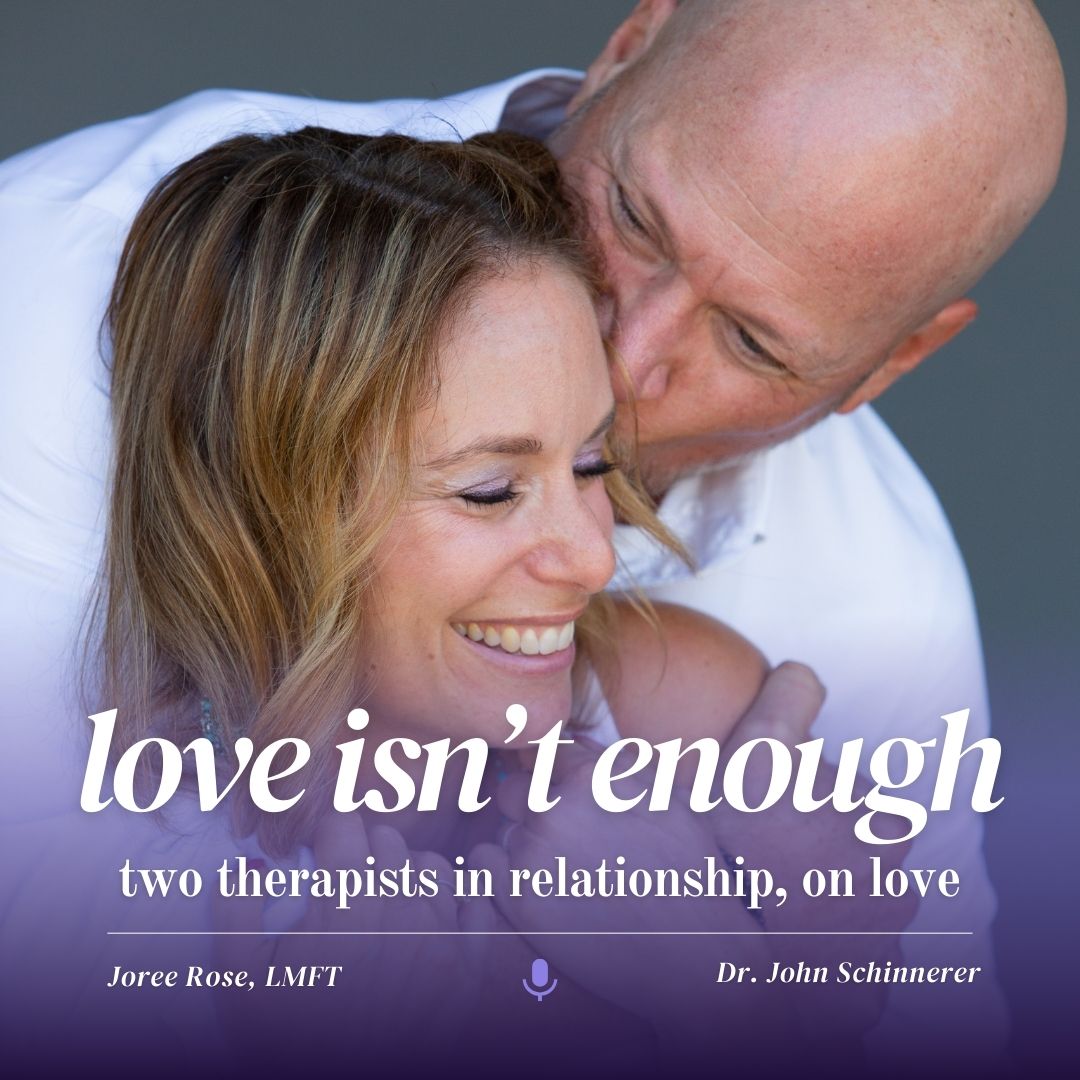
In this episode of Love Isn’t Enough, Dr. John Schinnerer and Joree Rose, LMFT share their personal journey of healing from deep-rooted attachment wounds. They open up about the patterns they carried into their relationship—especially the anxious/avoidant dynamic that kept them stuck in cycles of disconnection—and how they consciously did the work to break free from it.
Through honest reflection and therapeutic tools, Joree and Dr. John reveal what it took to stop reacting from old wounds and start relating from a place of safety and trust. They discuss how healing isn’t just an individual journey, but a relational one, and why creating a secure attachment—within themselves and with each other—is the foundation for a thriving partnership.
Whether you’re in a relationship, seeking one, or doing the inner work to heal your past, this episode offers hope, insight, and practical tools for growing into deeper connection.
In this episode, you’ll learn:
-
How attachment styles actually show up in real fights—especially the anxious/avoidant “cat-and-mouse” cycle (pursue vs. withdraw).
-
Why conflict is the real attachment “lab”: when life is easy, your wounds stay quiet; when you’re triggered, your wiring runs the show.
-
The two core fears underneath the pattern: anxious = abandonment, avoidant = not enough / shame—and how both are really about safety.
-
How stonewalling and “I need space” can feel like abandonment, even when it’s meant as self-control and harm prevention.
-
A practical repair rule: if you take a break, name the time and promise the return (and why 20 minutes matters for nervous system reset).
-
Why “soft startup” communication works (and how it removes the excuses and exposes the real trigger as “old stuff,” not the current moment).
-
How to spot when your reaction is outsized—and the key insight: big reactions usually mean the past just hijacked the present.
-
The shame-to-shutdown pathway (especially for avoidant partners): how “I’m not good at relationships” quietly drives withdrawal and defensiveness.
-
How IFS (Internal Family Systems) helps: identifying the younger “part” that takes over, thanking it, and updating the strategy for adult life.
-
The three levels of healing required: cognitive (understanding), emotional (feeling), and nervous system/physiology (trauma + regulation).
-
Why deep breathing isn’t a cliché—it’s the on-ramp to choice: regulate first so you can respond instead of react.
-
How to reframe conflict as “us vs. the pattern” instead of “me vs. you,” so you can interrupt the cycle without blame.
-
How a relationship can support healing without becoming the “fixer”: your partner isn’t responsible for repairing your childhood wounds—but love can help you rewire.
-
What “secure” actually feels like: you can handle disconnection, ask for reassurance, repair, and trust your partner isn’t going anywhere.
-
A simple post-fight ritual: revisit the conflict later with curiosity—“What was happening for you? What did you need? What would help next time?”
Connect with Joree & Dr. John and Love Isn’t Enough:
• Website: www.loveisntenough.net
• Instagram: @loveisntenough33
• Subscribe to their podcast: Love Isn’t Enough
• Join our relationship Master Class series: https://loveisntenough.net/masterclass/
Connect with Joree Rose:
• Website: www.joreerose.com
• Instagram: @joreerose
• Subscribe to her podcast: Journey Forward with Joree Rose
• Join the Podcast Membership: https://joreerose.com/
journeyforwardpodcast/
Connect with Dr. John Schinnerer:
• Websites: www.GuideToSelf.com | www.TheEvolvedCaveman.com
• Instagram: @theevolvedcaveman
• Subscribe to his podcast: The Evolved Caveman
If this conversation resonated, here are a few ways to go deeper:
• Subscribe to the Love Isn’t Enough podcast
• Leave a review—Scroll down and click Write A Review. It helps more couples find this work
• Join our Monthly Relationship Masterclass on building an emotionally safe and thriving ‘ship
• Work with us directly in couples counseling or coaching. Email (below) to inquire about availability
About Your Hosts:
Dr. John Schinnerer is an executive coach out of U.C. Berkeley specializing in emotional intelligence, anger, the evolution of men, and relational health. He has worked with men and couples for over 30 years. He was an expert advisor on the academy award-winning movie, Inside Out. His online anger management class has taught over 25,000 people how to reduce their anger for a happier, calmer life.
Joree Rose, LMFT is a marriage and family therapist focused on emotional safety, attachment, and healing relationship wounds. she has focused on guiding women to greater life satisfaction and purpose and has written several books.
Full Transcript Here
From Reactive to Relational: How We Healed Our Attachment Wounds – Transcript
Joree Rose, LMFT: Hello and welcome to this week’s episode. This is a lot all in one. We are two people with three podcasts in this episode. It’s gonna go out on all three. Why? Because we think this topic is that important.
Joree Rose: I’m Joree Rose, host of Journey Forward with Joree Rose.
Dr. John Schinnerer: And I’m Dr. John Schinnerer, host of the Evolved Caveman.
Dr. John Schinnerer: And together we do Love Isn’t Enough.
Joree Rose, LMFT: Love Isn’t Enough. So what is so important that we would wanna put it out on all three of our podcasts, John, you got the answer?
Dr. John Schinnerer: Attachment styles in relationship.
Joree Rose, LMFT: So in my Journey Forward podcast, the month of July, I’ve been talking about attachment styles, secure attachment, insecure attachments, mainly those being the avoidant or anxious.
Joree Rose, LMFT: So we’ll give a recap on all of those, but what we wanna be able to have today’s episode be about is what it actually looks [00:01:00] like in a real life relationship and lucky for you. You’ve got us to be vulnerable, to learn from, to hear about our mishaps, our growth opportunities, our struggles, our strengths, ideally.
Joree Rose, LMFT: So we can not just role model, but inspire you to do the work that we’ve done to go from an insecure to a secure attachment style in our relationship, which. I’m so proud of that we’ve been able to do this work together well,
Dr. John Schinnerer: And one of the things that I think thrills me about the attachments to how research and our own personal experience is that these attachment styles really seem to underlie a lot of the behavioral dynamics that we get into.
Dr. John Schinnerer: Our relationships, mainly how we argue, how we repair, how we recover, how we build trust, how we build or don’t build a relationship that has safety and security. Because that’s the real goal here is can we build a relationship that feels safe and secure to our physiology, to our nervous [00:02:00] system. One that we know our partner has our back, one where we know we can trust our partner with absolute certainty.
Joree Rose, LMFT: And one of the main areas these show up is during conflict because life is easy when it’s easy, right? When we’re getting along, when we’re doing things that are fun, when we’re having sex, when we’re not dealing with conflict, there’s no need to really tap into any underlying wounds. Life is easy when it’s easy.
Joree Rose, LMFT: However, when we look through the lens of attachments, every argument, disconnection, fight feeling lack of safety, there is likely an attachment wound, some insecurity sensitivity, so spot likely rooted long ago that is at the core of causing that disconnection of where you may misinterpret your partner’s words or cues or behaviors based on how your brain was wired.
Joree Rose, LMFT: When you hold on, how your brain was wired when you were young to understand what does [00:03:00] relationship look like
Dr. John Schinnerer: because I think it’s not only misinterpreting your partner’s cues, it’s also misinterpreting your own
Joree Rose, LMFT: a hundred percent. And that’s
Dr. John Schinnerer: one of the key parts to me is. A hundred percent accountability for your own behaviors, your own actions, your own emotions.
Dr. John Schinnerer: Yes. And that’s where the real pivot takes place in my mind.
Joree Rose, LMFT: No I think that’s huge. So maybe let’s just give a foundation so I know years ago you and I did a podcast on the anxious avoidant trap, which we’ve gotten great feedback on, and. We don’t get stuck in that dance anymore. So I see this episode.
Joree Rose, LMFT: If you listen to that one a couple years ago, this is the here’s here’s our update. Here’s where we’ve done our work since then, because we were just beginning to get out of that anxious avoidant dance. We’ll talk about what that means, but we hardly ever. Get stuck in that dynamic anymore.
Joree Rose, LMFT: Yeah. Ever. So let’s give a quick recap. Okay. Do you wanna do that or should I,
Dr. John Schinnerer: do you wanna do the attachment styles? Sure. And then we can go, yeah, why don’t you’re a little bit better than at that [00:04:00] than I am.
Joree Rose, LMFT: Thank you, love.
Joree Rose, LMFT: In a nutshell, a secure attachment is the goal. This is the wiring of our brain that we had at an early childhood, that our primary caregiver was gonna be there for us.
Joree Rose, LMFT: So imagine you’re a little baby, you start to crawl, you go wander off and play when you come back. Primary caregiver, usually mom. Ideally is always there. If mom is there, that tells you’re safe. You can go off and explore the world knowing that your person is gonna be there when you get back
Dr. John Schinnerer: and what percentage of the time as parent, ’cause parents might listen to this thinking, oh my God, I have to meet my child’s responses and needs a hundred percent of the time in order to make them secure.
Dr. John Schinnerer: What’s the percentage of time that we need to meet our child’s needs to create a secure attachment style?
Joree Rose, LMFT: My guess, if you’re listening, you’re gonna think it’s 50%, 70%, a hundred percent, but research shows based on Donald Wilcots research back in the fifties, you only need to meet your child’s emotional needs 30% of the time to give them a strong [00:05:00] foundation.
Joree Rose, LMFT: Now you need to be available. The the majority of the rest of the time. It’s not like you can do 30% and then just not show up at all. But this is the idea of being a good enough parent.
Dr. John Schinnerer: And I, think of it as 30% of the time I’m at my best.
Joree Rose, LMFT: Right?
Dr. John Schinnerer: And I can respond at my best to my child’s needs.
Dr. John Schinnerer: But I think, and then there’s a lot of other times when I’m tapped out or exhausted or stressed or whatever, which I’m less than,
Joree Rose, LMFT: but I think that would give parents a lot of permission to be like, oh. I can actually do that. And if we transfer that from partners or from parents to our partners, my guess is the research would be somewhat similar.
Joree Rose, LMFT: What do you think? I would it seen, but I imagine it would translate and
Dr. John Schinnerer: I, think it’s interesting for those with anxious attachment styles who might have the perception or the belief that my partners should respond a hundred percent of the time perfectly to my emotional and relational needs. And I don’t think that’s true at all.
Joree Rose, LMFT: Huh. Speaking from someone who used to be anxiously attached, it really would’ve been nice if someone [00:06:00] could have met my needs a hundred percent of the time that I’m like, oh.
Dr. John Schinnerer: But I think it’s important to say no. I know I expectations, and I, think actually in relationship, 30% might be a little bit low.
Dr. John Schinnerer: Yeah. Looking at our patterns I I, shoot for 80 to 90%.
Joree Rose, LMFT: Okay. Hold on. We’re jumping around here, but I think this is really important. Thank you for shooting for any 90%. I think it’s a great, intention, and
Dr. John Schinnerer: then there are those nights when I just roll over and go to sleep. But those are pretty infrequent.
Joree Rose, LMFT: But I think we could use the research from the Gottman’s on bids for attention as a similar dynamic of responding to needs.
Dr. John Schinnerer: Yeah, so it’s about 70%?
Joree Rose, LMFT: Yeah,
Dr. John Schinnerer: 67%. Okay, so
Joree Rose, LMFT: I take back what I said earlier. 30 percent’s not enough for your partner Anyhow, getting back to the basis of a secure attachment, baby goes off to wander and play.
Joree Rose, LMFT: They come back, mom is there. That wires their brain for feeling safe and secure and trusting others to know that others will be there for them.
Joree Rose, LMFT: Research shows that’s about 50% of the population has a secure attachment, an [00:07:00] insecure attachment. Generally Brit’s broken down into two categories, anxious or avoidant.
Joree Rose, LMFT: There’s a disorganized, which is a little bit more complex, might have more trauma involved, a little bit more calm. Complex of diagnose and ptsd. Yeah. Yeah. There might be trauma PTs. But that’s
Dr. John Schinnerer: pretty rare. It’s pretty infrequent. It’s pretty,
Joree Rose, LMFT: we’re not gonna talk about the disorganized, it’s pretty
Dr. John Schinnerer: extreme also in how it presents.
Joree Rose, LMFT: We’re focusing on the anxious and avoidant ’cause that’s what’s more common. Interestingly enough, anxious of attachment styles tend to lean about 70% women. 30% men avoidant tend to do the opposite. 70% men, 30% women. But what does it mean baby goes off to wander and play? Sometimes mom is there when they come back, sometimes they’re not.
Joree Rose, LMFT: It’s intermittent. It’s like a slot machine, but they’re in there enough to keep you wanting to come back for more. That’s an anxious avoid. That’s an anxious attachment style. That’s how the brain gets wired to not trusting somebody. Having that insecurity of, I don’t know if they’re gonna be there for me.
Joree Rose, LMFT: So when that’s the case, they can easily kind of glob on when someone is [00:08:00] there for fear of, I don’t know how long they’re gonna stay. Someone who is anxious during conflict is gonna approach, is gonna seek connection in order to regulate their nervous system to feel safe and secure once again.
Dr. John Schinnerer: And what’s the underlying fear?
Dr. John Schinnerer: The biggest wound
Joree Rose, LMFT: abandonment.
Dr. John Schinnerer: Yeah.
Joree Rose, LMFT: Underlying fear is abandonment. Interestingly enough research also shows that those who are anxious they tend to have a hard time looking at themselves in a dynamic of conflict. It’s easy to think if only the other person were available, I wouldn’t be acting this way.
Joree Rose, LMFT: So that’s a really interesting thing we’ll talk about when we get into our styles. ’cause that was hard for me being the anxious. I thought that the problem was really just John’s avoidance and if he just wasn’t being avoidant, we’d be fine.
Dr. John Schinnerer: The other piece about anxious attachment style people that I find fascinating is in a relationship, they’re typically the one doing the work.
Dr. John Schinnerer: They’re typically the one reading books, listening to podcasts. They’re going to therapy. They think their shit has been covered and [00:09:00] dealt with, and the T’s are crossed and the I are dotted. But what they don’t realize is that there’s this pursuit dynamic and this externalization of blame that becomes soul crushing or can become really difficult in relationship because their externalization leads them to believe that if I just, if my partner could just fill in the blank, I’d be happy, I’d feel safe and secure, and it’s not quite that simple.
Joree Rose, LMFT: It’s not that simple. So the avoidant, going back to that model of the baby, a baby goes off to wander and play, and primary caregiver is hardly ever there. So their brain gets wired to really not trusting anybody. Learning to become ultra reliant on self. Fearful of relying on others. ’cause again, they don’t trust that they’re ever gonna be there for them.
Joree Rose, LMFT: During conflict. They tend to shut down, withdraw and seek isolation to regulate their nervous system. One of their underlying fears or wounds is not being enough. [00:10:00] Shame because if I were more, then my mom would’ve been there for me.
Dr. John Schinnerer: And you can see how males are overrepresented in this. If you think of how we’re socialized as young boys, it’s things like, man up.
Dr. John Schinnerer: Boys don’t cry. You want something to cry, I’ll give you something to cry about. And so our emotional needs are met with anger, disdain, disgust, and put downs. And so we just learn from a really early age, I better shut that shit down. Yeah. And so we learn to dissociate from our emotions at a really young age.
Dr. John Schinnerer: And it’s fascinating to me because a lot of avoidant men that I’ve talked to, I guess avoidance in general that I’ve talked to say, yeah, my childhood was great. It was perfect. There was nothing wrong. My mom and dad were great. But what is happening much of the time is that because we’ve disassociated from our emotions, we don’t have the emotions to sear the memory into our mind, and so as a result, they’re not there.
Dr. John Schinnerer: And so we actually do think. That our childhood was idyllic and perfect
Joree Rose, LMFT: because we do, [00:11:00] but it’s not
Dr. John Schinnerer: the case.
Joree Rose, LMFT: We do need a emotion to create long-term memory.
Joree Rose, LMFT: So that’s a really fascinating piece and you can see where this dynamic, if one partner’s anxious and the other is avoidant, you get this cat and mouse situation.
Joree Rose, LMFT: So during conflict, the anxious is gonna step towards and the avoidant is gonna step away. And. Oftentimes that dynamic in and of itself can become the new focus of the original conflict and what was underlying the, dance might get pushed to the side because now we’re in a new challenge. We’ve gotta negotiate our way out of
Dr. John Schinnerer: And, I think it’s interesting with, that dynamic that the, anxious attachment style at an extreme will pursue hard because they are believing, they feel that I can’t relax.
Dr. John Schinnerer: I can’t get back to a relaxed state of being until we reconnect, which makes a lot of sense. But this takes it a little bit too far and I’ve seen it go so far where the avoidant is saying, Hey, I just need to time out. I need some space to [00:12:00] calm down, which is what our MO is. And the anxious attachment style individual will pursue so much, they can’t give their partner the space to calm themselves and they’ll pursue, like even when the person’s backing into the bedroom and trying to shut the door, they got a foot in the door.
Joree Rose, LMFT: Having been that person, I don’t think I pursued to that degree. I was much more respectful of your space. I’d like to think, I hope I was at times it was really hard for me. But part of the challenge, if you’re that anxious is. A perceived inability to regulate your nervous system on your own.
Joree Rose, LMFT: It’s like you need someone else there to lean into, to lean on for comfort, safety, security, reassurance. And it’s really ultra dysregulating of, oh shit, you mean I gotta do that on my own. And because the avoidant has stepped away, that heightens the sense of abandonment. And we know from the research of the Gottman’s with an argument, taking a break is really a [00:13:00] productive use of your time and energy.
Joree Rose, LMFT: It is the number one thing in a conflict is just to self-regulate before you can even talk about what’s going on. One of the keys there is if someone’s gonna be taking space, is to reassure the other person how long you’re gonna need that break. Minimum of 20 minutes to fully regulate, but let them know I will be back.
Joree Rose, LMFT: So that can offer the anxious person reassurance without going too long into dysregulation.
Dr. John Schinnerer: Yeah.
Dr. John Schinnerer: So let me talk about the avoidant experience from the inside out. Okay. If you don’t mind. So what please, what my experience was when Jory and I would get into an argument and really. Going back to childhood or adolescence for me was when Jory would come at me and she would come at me very kindly, very calmly, generally.
Dr. John Schinnerer: And
Joree Rose, LMFT: can I say how I would say it?
Dr. John Schinnerer: Yeah.
Joree Rose, LMFT: I would say something like, Hey love. I just wanna let you know that what you just said hurt my feelings.
Dr. John Schinnerer: And that was enough [00:14:00] to give me, to put me in a place of I’m not enough. And ultimately, shame. And if you had asked me 5, 6, 7 years ago, if I had any shame in me, I would’ve been like no, But shame at its basis is the belief that we are unworthy of love, connection, and belonging per Brene Brown. And I think that’s a really good and accurate description. And so where I used to go I could, hang in there for about 15 minutes in a disagreement, and then I would start to get flooded.
Dr. John Schinnerer: And when I got flooded, I would go to shame. And the only way I could identify shame in myself is that in retrospect, in hindsight, by looking at it and thinking about it, I realized that I would have a couple minutes. Of thoughts like, I guess I’m just no good at this relationship stuff, or she’d be better off without me.
Dr. John Schinnerer: Now, both of those underlying that has a belief that I’m unworthy or unable to connect. And by the way, shame is always lying to you. There’s nothing you can [00:15:00] do that I believe that would make shame appropriate or true. And so I would get to this place where I would just shut down. I would get overwhelmed.
Dr. John Schinnerer: I would go to anger because I wanted to externalize blame. If you would just stop doing this, I wouldn’t be so flooded. I wouldn’t be so angry.
Joree Rose, LMFT: And it wasn’t even stop doing that. It at times when we would get stuck in those dynamics, it was an externalization of blame to my sensitivity. I like, I don’t understand why that hurt your feelings.
Joree Rose, LMFT: It was a questioning of times of I can’t believe. That bothered you. And so then I would go into this spiral on my end of I’m too much. My emotions are too much. I’m too sensitive. I can’t express my truth. My emotions push people away. And as you would go into shame and withdraw, in my mind, that validated my experience of my emotional sensitivity.
Joree Rose, LMFT: Well,
Dr. John Schinnerer: And that’s a classic one that we didn’t get into, but we hear with clients a lot and you hear it from men. Traditionally of telling their partner, [00:16:00] female partner, you’re too needy, you’re too much. Why are you so needy? And it’s a classic way to try to shut down your partner’s emotional needs. But when I would get to that flooded state in a, when we were in a disagreement, one of the things that would happen is I would, I’m trying to explain my behavior to myself, and I’m thinking, okay, I’m getting upset.
Dr. John Schinnerer: I’m getting flooded. I need to just be quiet because otherwise I’m gonna say something that I’m gonna regret. I’m gonna say something that’s gonna hurt Jo’s feelings. Now, that’s a great rationalization from the inside out. The problem is from the outside in, from Jo’s perspective, it is stonewalling. It’s me unilaterally cutting off the disagreement, the conversation, the connection.
Dr. John Schinnerer: Connection. And I’m saying to me, I just can’t deal with this. I need to shut this down before I do something in error or in anger. But to her it feels like complete emotional abandonment. And we know from the Gottman’s research that stonewalling is one of the four horsemen of the [00:17:00] apocalypse, which is likely to lead to a dissolution of the relationship.
Joree Rose, LMFT: Which partly we had that piece of it before our breakup and, I think one of those issues, we started having some real challenges in our relationship when we were in Italy. And that disagreement we couldn’t get out of. And it was interesting because we would get in this dance.
Joree Rose, LMFT: And the hard part too, about the anxious person in that dynamic was, I felt like my needs or my need for emotional regulation through connection inherently came secondary to John’s avoided need for space. To regulate before connection. And that really felt imbalanced and unfair to me. And
Dr. John Schinnerer: I think there was truth to that.
Dr. John Schinnerer: I don’t think I’d ever considered until a couple years ago to put your emotional needs first in that moment of disagreement.
Joree Rose, LMFT: And there were times we had the realization that I was having a bit of a trauma response. It wasn’t just anxious [00:18:00] attachment. And that was helpful for you to step towards, but I also had to really.
Joree Rose, LMFT: Learn how to self-regulate in those moments of real big disconnection. And I remember when we were in Italy and we were in one of those moments, it was a big deal for me to say, fuck it, I’m not gonna keep trying to pursue, to connect. I’m going for a walk. And woe was me. I was in Lake Como. I went for a gorgeous walk and ended up sitting alone along the lake and having a glass of champagne.
Joree Rose, LMFT: So I ended up, being just fine. Nice alternative, but it was, it felt empowering for me in that moment to be like, I’m gonna be the one who’s gonna walk and go take some space. That was a big turning point for me in recognizing pursue was not the only way I could regulate, especially when it wasn’t able to be met in those moments.
Dr. John Schinnerer: Yeah. And, I think the big turning point for me was realizing that shame was at the core of my behaviors. And I really wanna encourage all the avoidant [00:19:00] attachment style people out there, male and female, to consider, to truly consider with curiosity. To what extent am I dealing with shame?
Dr. John Schinnerer: And I think it’s at the crux, it’s at the heart of a lot of this. If you reframe it as to what extent do I feel like I’m not enough. Relationship. To what extent do I feel like I’m not pulling my weight or I’m just not very good at this relationship thing? Because the avoidant always has one foot in the relationship and one foot out of the relationship as a way to keep themselves safe because intimacy, real intimacy, real trust, scares the crap out of us.
Dr. John Schinnerer: We are afraid of being engulfed and smothered and afraid of losing ourselves.
Joree Rose, LMFT: So can you go into a little bit further, how did you heal that part? One, if someone recognizes they have shame underlying these behaviors, how did you go about dealing with that? In a way that was [00:20:00] not further shame inducing.
Joree Rose, LMFT: ’cause that really could spiral someone into some deeper wounds.
Dr. John Schinnerer: Yeah. I think the way I did it and the way I have to do a lot of this stuff, actually going back to childhood, like learning to ride a bike, I would have to do this stuff solo. I just felt more comfortable that way. Meaning, meaning like when I rode a bike, I, no one helped me.
Dr. John Schinnerer: My dad, tried to help me when I was like five. But I couldn’t quite get it, so I just waited. I, and then I finally started practicing in the backyard on my own, just going in little circles. But that way no one was watching. There was no embarrassment. There was no failure in my mind, no one to see it anyway.
Joree Rose, LMFT: ’cause I, can I interject one second.
Joree Rose, LMFT: When we got back from Italy and we went to a therapy session. Right off the bat, you had dissociated and shut down and that dynamic was not serving you to be able to look at it. And so that’s an example of where you couldn’t do it with me or even getting the support, but you also did get some ultimate access to some different tools through if FS with a different therapist.
Joree Rose, LMFT: Right. [00:21:00]
Dr. John Schinnerer: And I also think that for avoidance, at least for me, I had achieved my way outta shame and depression the majority of my life because it’s the thought of if I’m doing this and I’m doing this and I’m getting awards and I’m doing this and I’m getting this degree. How can I be depressed?
Dr. John Schinnerer: How can I be ashamed? And yet it’s still there.
Dr. John Schinnerer: And so one of the things I did is got the book No Bad Parts, by Dick Schwartz, who started IFS, internal Family Systems. Great theory in psychology. Relatively new, I would say 30 years old, early 30, 40 years. But relatively new in psychology.
Dr. John Schinnerer: The idea is that we have. A wise adult part to our personality. It’s kinda like we’re all multiple personality disorder to a small extent. So we have a wise adult part, that’s our core personality piece. And then we have all these parts of ourselves swirling around that main part. And the majority of the time your wise adult self is in charge of you.
Dr. John Schinnerer: But at times these parts will rotate out and take over. And the parts are pieces of yourself that were frozen in time, usually at a young age, 3, 4, 5, 6, [00:22:00] when you were in a difficult, scary. Frightening situation. Could be traumatic, maybe not, but something that disconnected you from a feeling of safety and security at that time.
Dr. John Schinnerer: At that age, you came up with the one defensive strategy that you could to survive. Could be acting out, it could be mouthing off. It could be shutting down. It could be hiding. There’s all these different ways that we can defend ourselves, but that one strategy and that part of you will rotate out when you’re in a similar situation now as an adult.
Dr. John Schinnerer: And so you had a great. Quote the other day with a client. It was something about how we develop strategies in certain contexts. Then the context change and we’re still trying to do the same strategies, which doesn’t work.
Joree Rose, LMFT: We don’t update the strategy given a new context, and it takes a deep level of awareness to recognize a, what the context was when you first developed the strategies.
Joree Rose, LMFT: But even before that, what is the wound that was created in that context? And how that strategy likely served you at some point, and then you kept that [00:23:00] strategy everywhere else you went. Not checking in to say, does that strategy fit for where I’m at right now, emotionally or relationally? Yeah.
Dr. John Schinnerer: And I, think one of the big things about this is awareness.
Dr. John Schinnerer: That’s the first step. The second step is to put a label on it, the, ideally the correct label, because just having, you can gain a sense of power and control over it when you have the language to put on it and explain it.
Dr. John Schinnerer: And so in my case, I think. I was ashamed at a very young age by my parents, and I don’t think it was anything awful.
Dr. John Schinnerer: I don’t think it was anything like, for that generation. It was considered normal, but even the, finger wagging and that you should be ashamed of yourself, I don’t think it’s helpful at all. I don’t think any of us should tell that to anyone ever. ’cause I don’t think it’s true. Maybe you should feel guilty.
Dr. John Schinnerer: Maybe you should be embarrassed. Not ashamed,
Joree Rose, LMFT: no
Dr. John Schinnerer: ashamed. The difference between guilt and shame is, guilt is I did bad and I need to make amends. Shame is I am bad and you’re never a hundred percent bad. No, never. [00:24:00] And so I, I realized that I was dealing with shame and so I thought, okay, I remember I was going down, I was on a six hour car ride down from the Bay area to la I got no bad parts on audio audible, which is a great way to do it ’cause.
Dr. John Schinnerer: Dick does the exercises and his voice is great to put you in a sleepy trance, but not great for the whole book, but he doesn’t read the whole book. So anyway, but I went through and just listened to the exercises in the book and did the exercises while I was driving. And basically what that entails is having calling out internally, you go in and you have conversations in your own head and you call out and have conversations with these different parts of you that are causing you trouble.
Dr. John Schinnerer: And so I targeted the part of me that was feeling shame and that would come out with shame in these disagreements. And it turned out he was four or five years old. I had a conversation with him. I told him he was loved, respected, admired, worthy. I told him, I thanked him for all the work that he had done to keep me safe or keep us safe over many decades.
Dr. John Schinnerer: And I said, look, you don’t have to have [00:25:00] this role anymore. Let me do you a favor and take this responsibility off you. You allow me to deal with those disagreements and how we’re feeling and how we respond and what we say, and I’ll promote you to head consigliere or head consultant like you always have my ear.
Dr. John Schinnerer: You can always talk to me and tell me your fears and concerns, and in exchange, let me take over these difficult moments. That seemed to work quite well.
Joree Rose, LMFT: It worked really well because once you were really aware of that part, if we got disconnected, I could even speak to that directly and say, what part is showing up that’s shutting you down right now?
Joree Rose, LMFT: And we could just interrupt it by having language to put to it, awareness to it, and for me. I really had to learn. I’m o I’m gonna be okay no matter what, which was really fucking tricky when John actually broke up with me and activated my deepest [00:26:00] wound of abandonment. And yet. Through that, I was able to gain the strength to say, I am okay.
Joree Rose, LMFT: I don’t want this, I don’t like this. I don’t want to have to go through this, and I can still handle that. And I think that breakup ironically, even though it activated my deepest core wound, gave me the strength to say, if I can get through that, I can get through the small disagreement. What are the skills and tools I drew upon to self-regulate?
Joree Rose, LMFT: Self-soothe? Tell myself, I got this. I can breathe through this. This is just anxiety. This is just fear. This is just emotion. And rewire that belief that I wasn’t worthy. ’cause at the root of it too, I felt like I actually I not worthy of connection, right? Whether it’s not enough or too much, there’s this internal belief of, oh shit, is someone really gonna love me if they really know me?
Dr. John Schinnerer: Yeah.
Dr. John Schinnerer: Ultimately, both anxious and the avoidant attachment styles have shame at the base.
Joree Rose, LMFT: Yeah, just
Dr. John Schinnerer: kind of different types of shame. [00:27:00]
Joree Rose, LMFT: So one of the things that I think is really important for couples is when, I start off with a new couple, when we work with someone from the very get go, one of the main questions I ask is, do you know your partner’s deepest wounds or insecurities or sore spots?
Joree Rose, LMFT: Because sometimes they do. I would say about 50% of our clients will say yes. The rest say, I’m not really sure they have a guess. But this is a really important thing because if we can have greater awareness around our partner’s, deepest wounds, ideally we wanna do our very best on our behavior to not activate in that our our relationship can be the source of healing for those older wounds, but the relationship is not supposed to heal it.
Joree Rose, LMFT: From that intention, like it’s a natural byproduct of our love to make us feel loved at other parts of our life. I can’t look to John and say, heal the wounds I got from my mother and my ex-husband. That’s not John’s job. However, John loving and accepting me and growing and healing with [00:28:00] me inherently will help those wounds heal.
Joree Rose, LMFT: I think that’s a really beautiful aspect of relationship when we can utilize this love, this opportunity, this relationship, to be curious, to heal, to learn to grow. Hopefully that’s what these podcasts are offering to someone listening is our brains are not wired in one way for our entire life. It’s.
Joree Rose, LMFT: Relationship and context dependent.
Dr. John Schinnerer: And you might be wondering if I’m the anxious attachment style, how do I get through to my avoidant partner or vice versa?
Dr. John Schinnerer: And it makes me think back to when I was married and my wife, now my ex-wife accused me of having an anger issue.
Dr. John Schinnerer: And I was like, okay let me take a look at that. And I was getting angry and I, think there was many valid reasons for anger at that time. However, I figured my anger, my responsibility. I did a lot of [00:29:00] work to really manage that anger to the point where when she was yelling at me and I had done nothing wrong, I could stay calm and respond appropriately.
Dr. John Schinnerer: Then it became quite apparent I dunno about to her, but to everyone else who had the anger issue, and it’s the same idea in this. And one of the things, are you saying
Joree Rose, LMFT: I have an anger issue? No, I’m, no. One of the
Dr. John Schinnerer: things that, that Jo did very well is she was very gentle about communicating to me when she did have a concern and she was calm and measured and she brought it up with a soft startup, Hey honey, I have something important to talk to you about, is now a good time?
Dr. John Schinnerer: So it took away all my excuses to say any, in any possibility, this is about you. It was apparent to me like, oh wow, my response to this is bigger than it should be. Like my emotional response is outsized, given what we’re talking about right now. And whenever you’ve got a bigger emotional response, you better look to the past for the [00:30:00] cause.
Dr. John Schinnerer: And so I, think that’s one of the things that she did very well that allowed me to focus on some of this is really my work and, that this, that, that work had nothing to do with this relationship. Was my individual work that I had to do outside of this relationship, which is one of the reasons why we started.
Dr. John Schinnerer: The Love isn’t Enough model where I see the man, she sees the woman, and then all four of us get together to do the couple’s work so that it gives room to do simultaneously the individual work and the relational work.
Joree Rose, LMFT: And. Thank you for doing that work, love. It has been an absolute game changer in our relationship and I think role modeling, not just to our daughters but our clients.
Joree Rose, LMFT: It’s possible because I think that was something we both were feeling pretty defeatist around of can this ever change and. For most couples, they likely are not starting at the baseline of where we were in terms of the education, the knowledge, [00:31:00] the research in knowing this. But that was one of the hard parts for us, is just knowing it doesn’t mean you’re able to enact it.
Dr. John Schinnerer: And on that point, if I may I, think there’s three levels of knowing this stuff. I think there’s the intellectual level, the cognitive level, the thinking level, which is where most of us will learn something like, oh, I know all about attachment styles. Okay, you know about them in your head. But then there’s also this level of heart or emotion and can you feel it?
Dr. John Schinnerer: Can you stay grounded even when you’re in the middle of a disagreement? And then the third level is the physiology or your nervous system level. ’cause sometimes there’s trauma from the past that precedes both those two earlier levels. And so you gotta heal all three of those levels in order to really master this.
Joree Rose, LMFT: Yeah, I think that was really beautifully stated. And at the core I think the.
Joree Rose, LMFT: Baseline tool to practice is to breathe. Right When we can really understand that taking deep breaths is gonna calm our brain, calm our body, get us to respond instead [00:32:00] of react, get us into the present moment, not stuck into the past or into that anticipatory unknown future, we’ve got a much better chance of accessing any of the tools that we have.
Joree Rose, LMFT: ’cause until we can regulate our nervous system, we’re gonna stay. In reaction mode, and that’s not gonna be a very relational stance.
Dr. John Schinnerer: And it’s interesting too, ’cause there’s a lot of things that are going to influence your physiology, that nervous system level that have nothing to do with your relationship or very little.
Dr. John Schinnerer: Right now we’re looking at the political climate, which is triggering a lot of people in fight, flight, freeze, fawn, or flop. That stress response is activated for a lot of people. Almost all the time or all the time, there’s work stressors, there’s financial stressor, stressors. There’s stressors of aging parents or stressors of your kids.
Dr. John Schinnerer: Those don’t have to do with your relationship typically, right? And so you gotta look at what other factors might be. Causing me to be, to have that [00:33:00] physiological activation going on, which makes it hard to relax when I’m at home and have a prayer of doing what we’re talking about.
Joree Rose, LMFT: I wanna name a couple things before we wrap up.
Joree Rose, LMFT: We’ve really focused this on a couple who are one person’s anxious and one’s avoidant. That is one of the most common dynamics. If you’ve got. One person who’s anxious and one person who’s secure, the secure person is likely gonna help rewire the anxious person’s brain to feel more safe. So they likely will not have the experience of that fear of abandonment or challenge during disconnection of, being alone.
Joree Rose, LMFT: Same thing if you had an avoidant and a secure person, right? The secure person is likely gonna be able to say, grounded and present and available to help show their partner, Hey, I’m here. I’m not going anywhere. So you rarely see those. And two anxious people. That would be a really combusting relationship ’cause they’re both gonna be coming at one [00:34:00] another.
Joree Rose, LMFT: I don’t see a lot of that in our work.
Dr. John Schinnerer: It’s
Joree Rose, LMFT: volatile. Yeah, it’s volatile and it is gonna maybe be highly passionate, which could have some benefits and to avoidance together. They’re gonna have a real hard time connecting. Now we have seen that. We have had some clients in which. There are two avoidance where turning towards is actually really dysregulating to the nervous system.
Joree Rose, LMFT: Communication is nil. There are no safe topics. So I think what we see most commonly is one anxious, one avoidant. Generally two anxious people are gonna be going at each other. It’s gonna be very volatile. We see that a little bit, but, and too avoidant. So it’s just different dynamics. But the most common one is the anxious avoidant.
Dr. John Schinnerer: Yeah and, realize these dynamics are unconscious and powerful. Jorie and I worked on a lot of different levels. Communication, emotional regulation. We looked at trauma, like there was a lot of things that we looked at [00:35:00] before we really found out and started working on our attachment styles.
Dr. John Schinnerer: But once we healed the attachment styles. Everything else fell in place
Joree Rose, LMFT: and one of the questions you can ask yourself during conflict or any argument or disconnection is, what is my attachment wound at the core of this right now? It it. Can really just throw a monkey wrench into the negative pattern.
Joree Rose, LMFT: And that’s another thing is recognize if you’re in these dynamics, it’s a pattern. It’s not you to identify that it is you and your partner against the pattern that you’re trying to solve, rather than you or your partner against one another. But seeing things through of what is the unmet need? Oftentimes we hear simple examples of, let’s just say.
Joree Rose, LMFT: One person in the relationship might say to their partner, Hey, did you empty the dishwasher or did you feed the dog? And sometimes even these real innocuous questions can lead to shame of not being enough. Why would you assume I didn’t take care of the dog? Or why would [00:36:00] you assume I wouldn’t do my chore?
Joree Rose, LMFT: That’s always mine. It’s, interesting that sometimes the most simplest things can set off the story in our head, and now we’re stuck in a spiral that feels really hard to get out of.
Dr. John Schinnerer: Like it makes me think of did you pick up Bobby at soccer practice? Why are you always accusing me of being a shitty parent?
Dr. John Schinnerer: Yeah, what I just asked if you picked him up.
Joree Rose, LMFT: So if we were to look at those examples with the question of what is the attachment wound or unmet need underneath that you would likely find, if you go back to childhood, some experience in which you were ashamed or blamed or accused of not doing something you were supposed to be doing.
Joree Rose, LMFT: So anytime anyone asks your brain. Unconsciously immediately goes back to that feeling, that emotion, that sensation in the body.
Dr. John Schinnerer: And remember as Antonio Demasio says, we are not thinking beings who feel we are feeling beings who think, in other words, the emotions are faster, stronger, and more primary. And that’s what we’re talking about here.
Dr. John Schinnerer: This is not a rational response. To [00:37:00] your relationship. This is purely an emotional and physiological response that takes over very quickly, usually before you have any awareness.
Joree Rose, LMFT: So what are the solutions here? You’re already doing it by listening, so hopefully you’ve learned something. Tools of mindfulness, awareness, presence, breathing staying in, a state in which you can learn the tools on how to respond and not react, curiosity, compassion. Dick Schwartz and his IFS work has eight different characteristics of when you’re in your wise adult self, that’s the gold standard of, if we can get back to those eight characteristics of compassion, curiosity, connection, calm.
Joree Rose, LMFT: I confidence there’s, I always forget all eight. You can easily
Dr. John Schinnerer: clarity, creativity. I don’t know. There’s,
Joree Rose, LMFT: I think we got most of them there we’re looking for root markers to stay grounded, to not be reactive. So we can, again, curiosity of what’s, going on underneath this? How can I stay present and then turn towards my partner?
Joree Rose, LMFT: Now, the only thing [00:38:00] that we didn’t talk about, I know we’ve talked about in other episodes, is how to help support these new dynamics.
Joree Rose, LMFT: Non-defensive listening, right? Because if you come to your partner and you’re trying to create new patterns and the other person’s defensive, it’s gonna shut down the intention of connection and it’s gonna make it really hard to develop new patterns, repairing well.
Joree Rose, LMFT: So we always often. With clients and with ourselves. Go back to a disagreement days after it happened with curiosity. Not to rock the boat, not to re-trigger the the issue that led to the disagreement, but with curiosity, Hey, what was going on for you there? Ideally, that gives you some space to have a little bit more wisdom into that attachment wound or unmet need that was triggered, which gives us the opportunity to really know.
Joree Rose, LMFT: Talk about that. Hey, what would’ve felt better in that moment? What would you have needed to hear? What could I have done differently? Can I give you another hug? What do you need right now if you do feel sensitive to that?
Dr. John Schinnerer: And a couple other things, just to wrap up.
Dr. John Schinnerer: One of the things that [00:39:00] might be helpful is EMDR which is a form of therapy in order to heal trauma.
Dr. John Schinnerer: And if someone, if one of the partners in a relationship has trauma, that can muddy the waters and make things a little bit more unclear and difficult. So healing the trauma is a good one. The other thing that worked for Jory and I was psychedelics. Psilocybin and MDMA and those helped us get through some of the stuck places where we could talk honestly and safely with.
Dr. John Schinnerer: It also, the MDME. MDMA in particular suppresses the fear response and floods you with positive emotion. So you can have some of these really difficult conversations and stay in it without getting flooded.
Joree Rose, LMFT: And both of those are able to help actually rewire your brain and patterns so you really can develop new ways of being.
Joree Rose, LMFT: So I hope this was informational, but also inspiring that if you are stuck in these dynamics. It is possible to get out of them. John has so lovingly done this work for our relationship rewiring beliefs. He never thought he could change. I believe I have grown [00:40:00] immensely from my anxious styles, even the fact that I.
Joree Rose, LMFT: My deepest wounds were activated and I’m still able to feel safe in this relationship. A safe, secure relationship is when is you. You trust your partner’s gonna be there. You can talk about things, and even if you get dysregulated, you know you have the ability to get through this, that my partner’s not going anywhere.
Joree Rose, LMFT: I am loved. I feel safe. I am secure. Sometimes that means asking for reassurance, right? It doesn’t mean you’re always gonna feel it, but having the safety to bring up the hard stuff is. Relationship gold and do your partner, the best favor you could give them is look at your own shit. That is one of the most loving, loving acts you could do for another is to be curious is how is my shit getting in the way of being available, present, supportive, or a good listener, or in being able to meet my partner’s needs?
Joree Rose, LMFT: [00:41:00] It is. I, can’t say that enough.
Dr. John Schinnerer: Yes. May we all have the courage to face our own shit.
Joree Rose, LMFT: So I hope that this episode was helpful. You’ve got one of three to choose from to give a rating, review, or share if it was something that resonated with you. And thank you so much for being part of our journey. We very humbly and vulnerably share what we went through in hopes that it inspires other couples.
Joree Rose, LMFT: To find their way towards security, because once you have that it’s, golden. Then there’s nothing to fear. You feel safe. You can get through challenge, you can get through hardship knowing that you’re a team. So thanks so much for tuning in today.