
Episode 11 – Break Up With Stress, Not Your Partner With Liz Earnshaw, LMFT
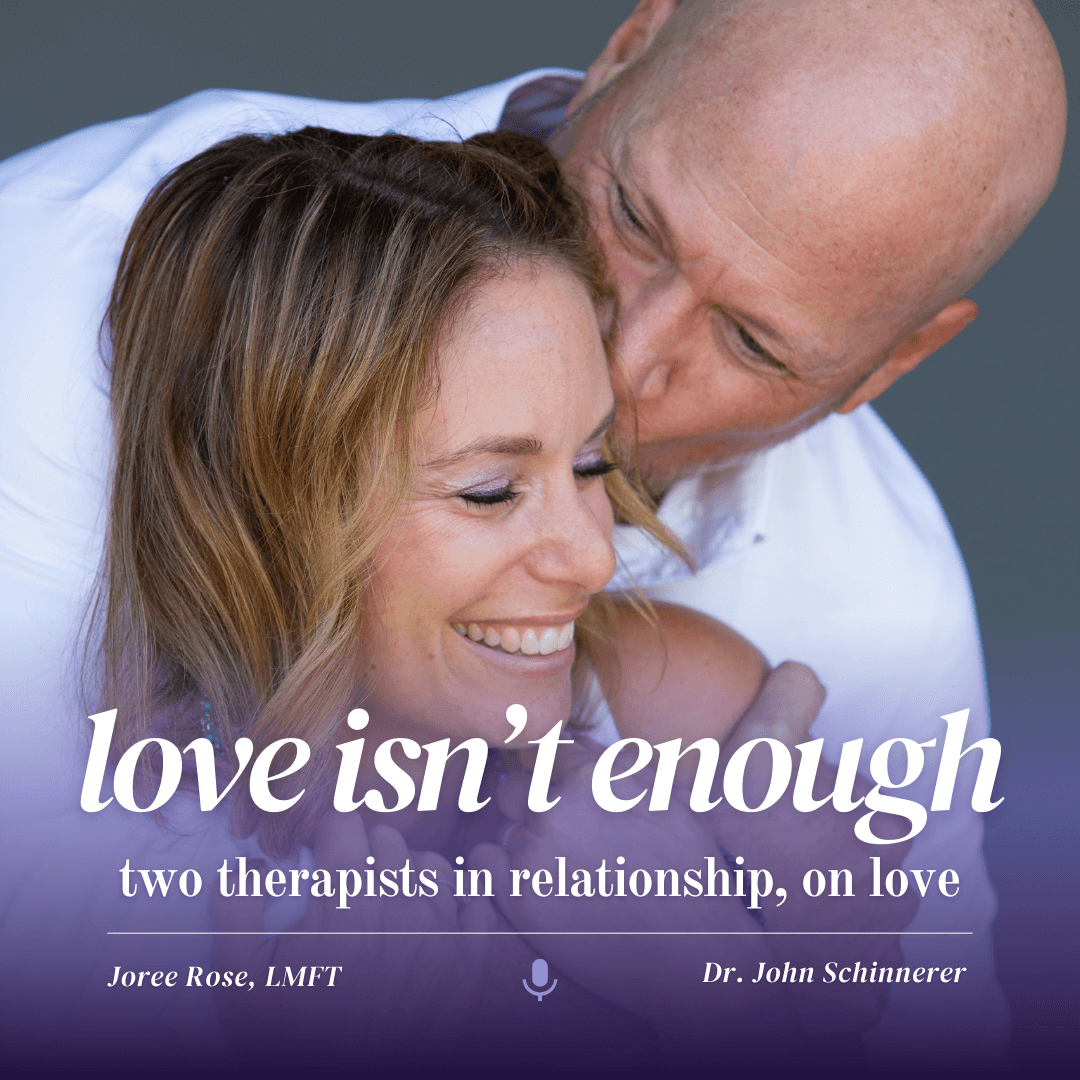
Connect with Joree & John:
• Website: www.loveisntenough.net
• Instagram: @loveisntenough33
• Subscribe to their podcast: Love Isn’t Enough
• Join our relationship Master Class series: https://loveisntenough.net/masterclass/
Connect with Dr. John Schinnerer:
• Website: www.guidetoself.com
• Instagram: @theevolvedcaveman
• Subscribe to his podcast: The Evolved Caveman
Connect with Joree Rose:
• Website: www.joreerose.com
• Instagram: @joreerose
• Subscribe to her podcast: Journey Forward with Joree Rose
• Join the Podcast Membership: https://joreerose.com/journeyforwardpodcast/
If you and your partner are getting negatively impacted by stress, this episode is for you!
Break Up With Stress, Not Your Partner w/ Liz Earnshaw, LMFT – Full Transcript
Joree Rose, LMFT: Hey everyone. Welcome to this week’s episode of Love Isn’t Enough. I’m Joy Rose here with my partner in life and love, Dr. John Chinner, and we are so thrilled to have our guest today, Liz Earnshaw. I’ve known Liz for years virtually and have had her on my podcast journey forward, and we meant to do this interview a few months ago, but life happened and.
Joree Rose, LMFT: Nonetheless. Here we are and we’re here to talk about stress and the impact that stress has in relationship. She wrote an amazing book Till Stress Do Us Part. So Liz, thank you so much for being here. Please introduce yourself and tell us why you wrote this book.
Liz Earnshaw, LMFT: Thank you for having me. And I’m Liz Earnshaw, a licensed marriage and family therapist.
Liz Earnshaw, LMFT: I’ve been practicing with couples for over 15 years now, and it is my passion. I love everything about it. I [00:01:00] actually like going to work because I enjoy seeing my couples. I’m also a mom and a wife. I have two kids and a husband live out in the suburbs, and I run a practice. Very busy. Which brings me to why I wrote this book.
Liz Earnshaw, Expert on Stress: I was facing a lot of stress in my own life, and I was wondering, and I know you both read the book, but I was wondering like, what is wrong with me? I’m a couple’s therapist. I should know how to get along with my partner, and I like flipping hate him, and I say awful things, and I’m kidding. I
Joree Rose, LMFT: don’t actually hate him.
Joree Rose, LMFT: So humility. We talk about that sometimes with ourselves, God damn it, we’re human.
Dr. John Schinnerer: It’s very frustrating.
Joree Rose, LMFT: Like we should know how to do this a little bit better sometimes.
Liz Earnshaw, LMFT: We can’t, like we, we can’t overcome the human urge to be human. So we had this great relationship and then we had a kid and a mortgage and jobs and it just was like a lot.
Liz Earnshaw, LMFT: And I was [00:02:00] noticing myself being really impatient, angry with him, and he was very distant and it made no sense because otherwise we had a good relationship. And I think. Often when people come to couples therapy, there’s this sense of we must have a bad relationship. I knew we had a good relationship and I knew I was a couples therapist and that I have all the rules and yet we could not get over it.
Liz Earnshaw, LMFT: We were arguing a lot and it was just pretty awful. And so I started to try to figure out like what is going on that is causing this and what I eventually came.
Liz Earnshaw, LMFT: To the conclusion of is this was really stress. Yes, there’s a lot of other things that we needed to learn, but really our stress was bringing it all to the forefront.
Liz Earnshaw, LMFT: I started to see it more and more. It’s when you get a car and you’ve never even noticed it on the road before, and then you get the car and every single person is driving.
Joree Rose, LMFT: Yeah, that’s the reticular activation system in action.
Liz Earnshaw, LMFT: Yes, exactly. So that was what it was like when I started. Everybody that came in, [00:03:00] I was like, okay, yes, you have some other things, but a lot of this.
Liz Earnshaw, Marriage Therapist: Is that you’re going through a lot and it’s impacting the way that you’re able to connect.
Dr. John Schinnerer: I think that’s a really good explanation, and one of the things I love about the book is I think that you’ve hit upon an important concept IE, chronic stress, being foundational in relationships, because it really speaks to what’s our self-awareness, what’s our body awareness?
Dr. John Schinnerer: How much awareness do we have when the sympathetic nervous system. Is in charge of us, the stress response fight, flight, freeze, versus how much are we aware when the parasympathetic or the relaxation response
Dr. John Schinnerer: Is running the show. And I don’t think most of us have much idea at all when that’s the case.
Dr. John Schinnerer: No, no awareness, and that’s a problem.
Liz Earnshaw, LMFT: Yeah, it’s a problem because we have these moments where we don’t behave like ourselves or our partner doesn’t, and we step away wondering what’s wrong with me or what’s wrong with them, and then it becomes this big blame game, whether it’s self-blame or [00:04:00] blaming the other person.
Liz Earnshaw, LMFT: When I’m working with couples, as soon as I bring this concept up, it’s a relief because they’re like, oh yes, I see that. That’s actually what’s been fueling a lot of this, but I haven’t been able to put my finger on what’s been fueling it and now I have this explanation of why. And they can start to see it more and have a little bit more control.
Liz Earnshaw, LMFT: Not control, total control, but a little bit more ability to. Respond differently just because they know where it’s coming from. So just that understanding makes a big difference.
Joree Rose, LMFT: Or at the very least, compassion. And sometimes I’ll say to clients, screw self-care. ’cause self-care often puts more to do items on our to-do list that we already don’t have time for.
Joree Rose, LMFT: But yet, self-compassion takes no extra time. It’s a mindset shift. It’s a turning inward that doesn’t have to add anything to your to-do list. And even with that awareness to be like, wow, yeah. This is a lot. No wonder I am overwhelmed all the time, [00:05:00] or short or irritable or not as organized or polite or forgiving, whatever it might be.
Dr. John Schinnerer:: I love these concepts and I think they’re quite powerful concepts where the idea is it’s not your fault, however, I would argue it is your responsibility to learn how to deal with it better. Yeah, because I think there’s so much in this life where we take personally and we think, oh, Jesus is my fault.
Dr. John Schinnerer, Expert on Man Box I’m not enough. I didn’t do well enough. And so the, these concepts where it’s just no, it’s just stress, like it’s just life. So it’s not your fault and it’s your responsibility.
Liz Earnshaw, LMFT: Exactly. I talk a lot with people about, I’m sorry that you have to be responsible for it, and you do because your only other option is for it to continue to be really crappy if you don’t take responsibility.
Liz Earnshaw, LMFT: Yes, it’s not your fault. It is really hard. It’s painful, which it didn’t happen and it did, and you have to do something about it.
Dr. John Schinnerer: So let’s talk a little bit about what is stress. You, I think, divided up into three types of stress, acute, chronic, and [00:06:00] eustress. Eustress being EU stress. For those that aren’t familiar with the term.
Liz Earnshaw, LMFT: Yeah, so that’s the positive stress. We need stress actually to be functional human beings. If we lived with nothing that was pushing us to grow and to work and to think, then we would just be bumps on a log. And so we, we want a certain amount of stress, and there’s a certain amount every day that when we have it, it helps us too.
Liz Earnshaw, LMFT: Be producers. It helps us to connect with people. It motivates us, but then we can face distress, right? Which is when it goes outside of really our ability to cope. And sometimes that is chronic. So chronic distress would be navigating an illness or navigating somebody in your family’s illness. It could be a job that’s really overwhelming or upsetting.
Liz Earnshaw, LMFT: It could just be the atmosphere that you live in, like the greater world. A lot of us have experienced a lot of chronic [00:07:00] distress that’s not even totally related to us, but is all around us and we’re being exposed to it all the time. I think
Dr. John Schinnerer: we could say the political atmosphere right now is creating chronic distress for.
Dr. John Schinnerer: A lot of people. So
Liz Earnshaw, LMFT: it’s both the way that it’s impacting you and also the exposure to seeing how it’s impacting
Dr. John Schinnerer: others.
Liz Earnshaw, LMFT: And so there is, that’s when it just doesn’t stop. You don’t, your body doesn’t get to come up for air and say, okay, I am safe again. Everything’s cool because you keep getting hit with whatever that distressing thing is.
Liz Earnshaw, LMFT: Then there is the acute stuff, and this is where you do get to come up for air. So you know you’re driving and somebody cuts you off and all of a sudden you feel like you almost got in a car accident. You got really bad traffic on the way home from work. It doesn’t happen every day. It happened just the one day.
Liz Earnshaw, LMFT: You had a really frustrating phone call with the cable company who overbuild you only happened once, but it’s really taken you outside of what your capacity is in that moment. [00:08:00] If acute stress is happening all the time, even if it’s a one-off, then you’re constantly getting back up and then getting hit again, getting back up and getting hit again.
Liz Earnshaw, LMFT: But if we just have acute stressors here and there, it’s okay. Our bodies get a moment, complete the stress cycle, move forward, feel calm again, know that we’re safe, but both of those things combined kind of change the way that we are feeling in our bodies and the way that we can react to people around us.
Joree Rose, LMFT: And there’s another massive piece that we look at the couples we work at who’ve got young kids, and you’re in that boat right now. We’re on the other side of that mostly empty nesting. That is inherently stressful. Yeah. That you enter into it, knowing this is gonna be a busy, chaotic, difficult but important and meaningful and values-driven and purpose-driven time of life.
Joree Rose, LMFT: And so sometimes we can’t escape what’s hard and. So what do you say to the couples when [00:09:00] they don’t really have a lot of ways to come up for error? If it’s not quite as bad as chronic, like an illness or something really toxic, but it’s that long-term, day-to-day, just constant overwhelm where they just don’t know if they can get a break.
Liz Earnshaw, LMFT: Yeah, so I would say most of the couples I work with, it’s that they, there is some sort of day-to-day overwhelm that is always there, and then there’s like other stuff that overwhelms them out of nowhere. So they are parenting young children and they’re both working full-time jobs. That’s already a lot.
Liz Earnshaw, LMFT: And then all of a sudden they’re in a big argument with their sister-in-law at the same time. And so when that’s happening, I like to be really real with people and say. This is life right now, you’re, it’s overwhelming. You’ve got a lot of different responsibilities that are pooling at you at the same time, and you’ve only got so much to give.
Liz Earnshaw, LMFT: And like you said earlier, a lot of compassion. This is real. This is [00:10:00] hard because I think sometimes people, especially with those stressors, make downplay it. They’re like, yeah, but this is what people. All my friends have kids. Everybody has a job. Why is it impacting us so much? And I always say it’s impacting everybody, right?
Liz Earnshaw, LMFT: You might not know it. And it’s, it is really hard. Even the meaningful stuff can be really hard. And so first, let’s accept that’s reality. So I work a lot with people just accepting this is reality sometimes. People don’t wanna accept that they have this. If I don’t look at it, it’s not real. So this is just a busy time because it’s the holidays, but as soon as that’s done, it’ll be less.
Liz Earnshaw, LMFT: Or my law firm is giving me a lot of work this month, but next month it should slow down and instead just saying, no. Actually, I think the reality is you’re gonna be pretty busy. For a while, let’s accept that. Once people accept it, then they can figure out, how am I gonna [00:11:00] take responsibility for it? What am I gonna do?
Dr. John Schinnerer: I love that idea that I think the surest path to misery is refusing to accept reality as it is struggling against that, trying to deny. And so I think acceptance, radically accepting that this is the reality right now. I’ll talk to couples about, look, I believe this is the hardest part in your life, the hardest period in your life is when you’re both working, when you’ve got young kids and there’s just not enough time and attention to go around for everyone in your life.
Dr. John Schinnerer, Anger Management Expert There’s enough energy to go around and that’s where we are right now.
Liz Earnshaw, LMFT: And like, how can you accept. That for yourself. And also have compassion for your partner too, because what I see a lot of is so much resentment. Of course, some of it fair. Maybe your partner really is slacking. Some of it though is.
Liz Earnshaw, LMFT: Oh my goodness. You both are under so much water right now and you’re both trying your best. You’ve [00:12:00] never been parents before. Some of the couples like they, it’s, this is a new thing that you’re figuring out, and yet you’re being really hard on each other about how you think the others should behave or what they should do.
Liz Earnshaw, LMFT: And sometimes I’m like, let’s just take a deep breath and think about. The fact that you are doing really well with a new task, even if it’s hard, you’re still
Joree Rose, Stress Management Expert: getting through it, even if it’s, you’re still getting through it.
Joree Rose, Mindfulness Expert: One of the things I really love about your book, Liz, is it gives a lot of very tangible practices and tools, and I think that’s what we need to offer, right?
Joree Rose, LMFT: Because this conceptual. Is great. And what, okay, now tell me what to do. We’ve been utilizing your book and tools in our masterclass series and we did our intro masterclass of the year of the three things that we see most getting in the way of couples stress being one of them. And one of the things that you suggested in the book I really love and just invite you to speak more about is.
Joree Rose, LMFT: [00:13:00] Just write down what your stressors are and share it with your partner because you are assuming that because you live together and you love each other and you’re parenting together and laughing together, that they know what’s going on inside of you, and that likely isn’t true. And I think it’s such a simple, but a really powerful intervention because I could look to John at times and assume why I think he might be irritable, but it might have nothing to do with my assumption, and it might be something that he didn’t think he should needed to share with me.
Joree Rose, LMFT: That’s really important information, and we’ve gotten really skilled over the years of not doing that and letting each other know exactly where we’re at and also being able to add on. It’s not about you because the interpretation very easily becomes it’s personal. What did I do wrong? I don’t get
Dr. John Schinnerer: irritable anymore because I’m a saint.
Joree Rose, LMFT: I never have. That’s
Dr. John Schinnerer: why I solved that problem.
Joree Rose, LMFT: They, the saints just removed your vision to testing further on your sainthood. Yeah. True. [00:14:00] To see
Liz Earnshaw, LMFT: if you would get irritable about that.
Joree Rose, LMFT: Have to say in, four months of him having no vision, he’s been irritable about it maybe three times for about two hours max.
Joree Rose, LMFT: Yeah. Yep. Each time, like literally, he’s been incredible. It would’ve been really understandable to have it cause a lot of issues between the two of us and for him to go into a dark hole. But this is lifetime of practice. Yeah.
Dr. John Schinnerer: For the listeners, I went blind in my left eye about four months ago. Retinal tear, retinal bleed in Portugal, and then had surgery a couple months later.
Dr. John Schinnerer So it’s just the backstory.
Liz Earnshaw, LMFT: What do you think that you’ve been able to do so that you don’t become irritable over something like that?
Dr. John Schinnerer: Oh I think practicing all the tools that I teach. Primarily one of the ones, one of the ways I think about stress is the gap between the challenge you face. And or belief that you’re up to the challenge.
Dr. John Schinnerer: And the bigger that gap is, the more stress you’re gonna face. And so one of the thoughts that I hear in my head that increase that gap going in the wrong [00:15:00] direction are things like, and they’re all first person singular, right? They’re, oh my God, I can’t deal with this, I can’t take it. I’m going crazy.
Dr. John Schinnerer: This is nuts. And you can hear there’s a tone of voice and an emotion attached to those thoughts, which is funny ’cause they’re just thoughts. When I hear thoughts like that. I try to catch them and reframe them as whoa, yeah, this is difficult and I can deal with this.
Dr. John Schinnerer: This is hard
Dr. John Schinnerer: and I got this.
Dr. John Schinnerer: Or I can handle this.
Dr. John Schinnerer: But I’m
Dr. John Schinnerer: also doing deep breathing. I’m also doing loving kindness. I’m also talking to joy and expressing how I feel.
Joree Rose, LMFT: I think part of it, he’s also been really good at receiving help and being vulnerable. That’s been
Dr. John Schinnerer: practice,
Joree Rose, LMFT: and I think for a lot of men in particular, that might be a big challenge when facing stress is to admit how hard this is to ask for help and then have the ability to receive the help.
Dr. John Schinnerer: It does affect my masculinity, my sense of self, my sense of identity in terms of for. Several weeks at [00:16:00] least. I wasn’t able to drive, I wasn’t able to go anywhere. I wasn’t able to see where I was walking. I couldn’t make love, I couldn’t go to the gym. There’s, I couldn’t work, I couldn’t see Couldn. Yeah.
Dr. John Schinnerer: And so there’s a lot I couldn’t do.
Dr. John Schinnerer: Yeah. I was
Dr. John Schinnerer: really trying. And then there was this period of five days where I was in Intenses pain because my eye pressure increased and that really pushed me to the breaking point of around day four and a half, day five. Where I knew when I was thinking like, just take the damn eye.
Dr. John Schinnerer: I’m not doing real well. Just get me outta the pain. I can’t focus this anymore. And for those five days, my use of tools was a little limited. Because I was just in so much pain.
Joree Rose, LMFT: And during one of the many appointments to the eye doctor walking to the parking lot, he said to me, do you think this has made us closer?
Joree Rose, LMFT: I was like, absolutely. Aw. And so I think it’s really beautiful that you can take a very stressful situation and it can break a partner. Break partners down. [00:17:00] Yeah. Or bring them closer. Yeah. And so what are some of the ways that you see continuing to break partners down, like criticism, shaming, blaming, externalization,
Dr. John Schinnerer: defensiveness?
Joree Rose, LMFT: What else do you see? Those seem like obvious ones, but
Liz Earnshaw, LMFT: yeah. Definitely criticism and defensiveness, COEs escalatory behavior with each other. So something that the two of you just discussed is that. Your relationship is at a place where you recognize somebody might be upset and the other person is able to kind of counterbalance that with some Dees explanatory behavior.
Liz Earnshaw, LMFT: Like kindness and we’re gonna get through this, and you have every right to be upset. Like anything that helps that other person feels soothed. But what breaks people down is when they escalate together, somebody says, I’m not gonna be able to handle this. I just want them to take my eye.
Liz Earnshaw, LMFT: I can’t even do it anymore. And the other person says something that kind of meets them there, [00:18:00] whatever they have to do. So you can get out of this funk, or this is a ridiculous way to look at it, or you think you’re the one in pain. I’m the one dealing with all the housework. And so the stress escalates together, which.
Liz Earnshaw, LMFT: As most things are, it’s completely understandable that other person is in their own body, is feeling overwhelmed and stressed, but they’re not able to take a deep breath and respond with warmth. Another thing that really breaks people down is resentment that they are not able to. Like retroactively go back and rework.
Liz Earnshaw, LMFT: And so I work with a lot of couples who, of course they don’t come see me when the resentment is building.
Liz Earnshaw, LMFT: They’re too busy, they’re stressed, they think they can handle it. They come see me when their kid is five and they’re still arguing about what happened. They haven’t been able to sit down with each other and say, wow.
Liz Earnshaw, LMFT: We were like little kids then it was our first kid and our baby was six months and we were sleep [00:19:00] deprived and we didn’t have family help. You know what? I was really mad at you ’cause you weren’t helping me. But looking back, you didn’t know anything. And maybe the other partner being able to say, I was really mad at you ’cause you were cold and mean and ignoring me.
Liz Earnshaw, LMFT: But looking back like you had a baby completely reliant on you. What else were you supposed to do? And they’re still saying, I hate you so much because you let your mother make fun of my wedding dress. I’ve never been able to get over it. This inability to move past resentments, not to just get over them, but to really be able to go back and say what really was going on there?
Liz Earnshaw, LMFT: Was it really that you both were horrible partners who had malicious intent and. You deserve all of this anger, or is it that you were probably going through a tension point in your relationship, which is what I almost always find. These resentments are some movement in towards a transition. You’re getting married, you’re having [00:20:00] a baby.
Liz Earnshaw, LMFT: Your kids have left home through these transitions that you mismanaged, and so mismanaged transitions and resentment. Those are two things that I see really pull people apart.
Joree Rose, LMFT: I think that resentment piece is so hard to name if you don’t have a good foundation at communication. And you’ve gotta be willing to let go of it.
Joree Rose, LMFT: ’cause we’ve worked with people, I’ve worked with women who are still resentful over what happened in the birthing room and now their kids are teenagers. Yes. I see it really less and as it, as the counter to that. When with John’s eye stuff, I wasn’t building resentment, but there were moments I was getting overwhelmed.
Joree Rose, LMFT: After he was out of that real acute situation and I felt like he could. Hold space for me, I was able to break down a little bit and say, my God, this has been really hard. And I didn’t wanna bring up what was hard for me because it was 10 times harder for him. And it [00:21:00] was still hard for me.
Joree Rose, LMFT: Watching the person you love riving in pain for days on end, that helplessness was gut wrenching. The overwhelm of just doing all the things around the house or missing connection ’cause he wasn’t able to. And he so graciously was able to hold space and be like. I could see how that was. That’s all I needed to hear.
Dr. John Schinnerer: And I knew, damn, she was over-functioning for months.
Joree Rose, LMFT: Yeah.
Dr. John Schinnerer: And there was nothing I could do about that. I was really grateful for her support. Yeah. And I think one of the things that we’ve worked pretty hard on is accepting each other’s emotions without judgment. I believe that if we can work to just listen to our partner’s emotions non defensively and just say, wow, honey, I can see where that was really difficult for you.
Dr. John Schinnerer: I’m really sorry.
Liz Earnshaw, LMFT: Yeah. Yeah.
Dr. John Schinnerer: It allows us to get those emotions out. And, yeah. And that it might take a couple conversations, 2, 3, 4, but that’s the path out of that resentment, I would argue, or Yeah.
Liz Earnshaw, LMFT: The resistance to hearing the other [00:22:00] person’s feelings, accepting it could be true for them, even if it’s not true for you.
Liz Earnshaw, LMFT: Is really, it’s a big one for couples, especially around stressful things, right?
Liz Earnshaw, LMFT: There might be a lot of resistance. You gave the example of the person whose kids are at college and they’re still saying, when I told you to get me an ice cube in the birthing room. You drank your soda Instead, you looked at me and you drank your soda and you knew I was thirsty instead of the partner, even 18 years later, being able to say What was wrong with me?
Liz Earnshaw, LMFT: That was such a boneheaded move. How would I not know you’re dehydrated and I’m drinking in front of you? Of course you were angry at me. Instead, even 18 years later, the partner will often say, why aren’t you over this? Yet it was once, don’t you remember? I was up for 25 hours. I thought my wife was gonna die.
Liz Earnshaw, LMFT: Can’t you care about what I have to, what I was feeling? And if, and I like, I often beat my head against the wall when people won’t go there because I say to [00:23:00] them, is all you would say, I’ll say in one-on-one sessions is all you would say is. I shouldn’t have had any of that drink in front of you. You were probably so thirsty.
Liz Earnshaw, LMFT: I’m sorry. It felt like I wasn’t caring for you. Clear
Dr. John Schinnerer: mono names clear.
Dr. John Schinnerer: Julie Ano names that game of who’s hurting most.
Dr. John Schinnerer: Yes, and I think we’re
Dr. John Schinnerer: often playing that game in relationship, right? Where my hurt is primary here, my emotions are primary, so I get that you’re angry or maybe I don’t get that you’re angry.
Dr. John Schinnerer: I was hurt more. Yeah. I was more angry. I was more sad. And so I’m gonna focus on my stuff.
Dr. John Schinnerer: Yes. And
Dr. John Schinnerer: that’s, it creates a negative spiral down to disconnection.
Liz Earnshaw, LMFT: Yep. I was more hurt, more angry, whatever. Or the other is, I actually don’t believe that what you’re saying is even upsetting. I wa I wasn’t upset.
Dr. John Schinnerer: It wouldn’t be upsetting to me.
Dr. John Schinnerer: How could it be upsetting to you?
Liz Earnshaw, LMFT: So what, and so sometimes, like you were saying with.
Liz Earnshaw, LMFT: The list of the stressors, [00:24:00] it’s really important to share them with each other. But I often have to tell people when your partner is sharing, you have to accept that it’s true for them. Because a place where they could get stuck is saying, I don’t understand this list of stressors.
Liz Earnshaw, LMFT: This wouldn’t be stressful for me. It doesn’t make any sense. I think you just need to let things go, and that too really prevents people from being able to clear the air and move forward and be connected.
Dr. John Schinnerer: I just wanna reiterate that point because I think it’s so important to accept what your partner is feeling despite how it would make you feel.
Dr. John Schinnerer: It doesn’t matter if you agree with it or not to accept it as true and real and valid for them. Is a game changer.
Joree Rose, LMFT: It’s huge.
Joree Rose, LMFT: I also love one of the other areas you address in the book of helping identify the reality and fantasy of how we’re setting up our life. And I work with a lot of women who I think are in the fantasy world of just what they can accomplish all at once.[00:25:00]
Joree Rose, LMFT: And it’s exciting, it’s momentum, it’s energy, it’s creativity, and it’s also not working.
Liz Earnshaw, LMFT: Yeah, and sometimes it feels like it is momentarily. You’ll have a break and you’ll decide, okay, this is like the moment where I could decide to roll in a new school program or gut my living room or spend money and I’ll be able to pay it back later, whatever.
Liz Earnshaw, LMFT: It’s like sometimes we get this false sense that it’s gonna work and then it. Doesn’t. But because we’re in that fantasy trying to bridge that gap, we can get really stuck trying to make it work, right? It becomes this sunk cost of, I already started this, so now I can’t quit it because I quit it. Or it costs a lot of money, or it costs a lot of time.
Liz Earnshaw, LMFT: And one of the things I work a lot with couples on is being able to shed some of that stuff that you brought into your lives because of that fantasy that’s, in many ways been fed [00:26:00] to them by watching the outsides of other people’s lives, by looking at social media, by what it looks like people can do, but really helping them to say it’s okay.
Liz Earnshaw, LMFT: To admit that we can’t handle all of this and that our lives might have to change in order for us to feel good instead of us looking good. Or keeping up the facade that we can do it even though we can’t.
Dr. John Schinnerer: But Liz, what about all the people I see on social media with perfect lives?
Liz Earnshaw, LMFT: It’s so fake, right? I’m like, yes, their kitchen looks beautiful, but I guarantee behind the screen there’s a whole bunch of Amazon boxes that they can’t even cut up and get rid of that they’re arguing over because everybody’s really exhausted about that beautiful kitchen that they just.
Joree Rose, LMFT: I know that you know this D ’cause it’s also mentioned in the book, and I think it’s such a great point.
Joree Rose, LMFT: So many couples think we just need to learn how to communicate better. We just have communication problems. Yeah. And that may be [00:27:00] true. I don’t think many people are taught or role modeled effective and healthy relational healing.
Joree Rose, LMFT: Communication. Whenever I work with new clients, I always give like a little brain science 1 0 1 and explain when your emotional brain’s taking over. It’s cut off access to all your resources, your tools, all that executive functioning. They don’t realize that even if they had the good communication skills, if they’re stressed, that emotional brains really compromise access to be able to even reach for that kind effective.
Joree Rose, LMFT: Intentional non-defensive communication. And I think it’s a really key point to name and you see it so clearly in the book. You don’t necessarily have a communication issue, you have a stress issue. ’cause if you weren’t a stress, you have a better ability to access the resources that give you the tools for the better communication.
Liz Earnshaw, LMFT: Exactly. Yeah. I think a lot of people come in, they say with communication issues and like you said. Many of us do need a little bit of help, right? We don’t see [00:28:00] what we don’t see. So often when couples are in the therapy room, it can be so helpful to say, Hey, I’m not sure if you realize this, but what you just said sounded really harsh.
Liz Earnshaw, LMFT: Did you notice that can be helpful? And at the same time, most people have the idea of what they’re supposed to do, right? If you said, should you be saying it that way? Most people could say, no, I shouldn’t be saying it that way. I know that ideally I would be able to say things gently and kindly and I wouldn’t get defensive, and I would share my feelings, but I can’t.
Liz Earnshaw, LMFT: And the reason you can’t is usually because you’re physiologically overwhelmed in those moments, and so it just comes out, or you get shut down or you get defensive. You do all of these things because. You don’t really wanna be vulnerable because it feels risky. And if you can soothe that and you can navigate either that acute stress happening in that moment, you’re in an argument or something, or the more chronic stress where you just never get a break, then you are more likely to do the things [00:29:00] that I think most people can naturally know they’re supposed to do.
Liz Earnshaw, LMFT: They might just not know how to do it.
Joree Rose, LMFT: Yeah. It’s such an important piece.
Joree Rose, LMFT: So you wrote this book as a result of your own life stress. Yeah. And. I am. That’s a eustress sort of thing, right? Of taking on something that was more stressful but creative and you wanted to do. What have you learned personally from this since your own challenges led to this book?
Liz Earnshaw, LMFT: For one, I’ve learned that it doesn’t really matter how many communication skills I have, it doesn’t matter that I’ve been doing this forever with a lot of people. If I am mismanaging my stress or my husband is mismanaging his stress, we’re gonna have. Not a fun time in our house, and if we are able to step back and say what is actually going on in our lives when we start to have conflict, why is this happening?
Liz Earnshaw, LMFT: Then the two of us come together as a team [00:30:00] wanting to combat that instead of wanting to go at each other. So something I’ve learned for myself is when we’re not getting along, one of the first things that I say either to myself or to him is what is actually going on? Right now, and that has been huge. I don’t say, why aren’t you doing that?
Liz Earnshaw, LMFT: There’s something wrong with you da. I say, why are we acting like this right now? What’s going on? And because of that, what we can usually do first is talk about what led us to having such a bad day with each other. He’s able to then say, I had gigs all weekend and I haven’t. I had two hours of sleep last night.
Liz Earnshaw, LMFT: And so I’m sleep deprived. And I can say, yeah. I just got 80 messages from work that are really stressing me out. We’re also very good at identifying that in each other. So when I’m not being myself, and that’s what we call it, not being ourselves, because then it’s less shaming, right? Says you’re not being yourself.
Liz Earnshaw, LMFT: And when you’re like this, [00:31:00] he will say, it’s usually ’cause something’s going on with work. Which is almost always the thing that kind of throws me over the edge is if I have too many work commitments at the same time. The other thing that we have gotten much better at doing is. This like retroactive forgiveness, which it’s.
Liz Earnshaw, LMFT: Yeah, I was upset with you last week. The way that you engaged in X, Y, and Z wasn’t ideal. I know that this was what was underneath all of that, and I am not going to hold that to you as like your character. I’m not gonna say, you don’t care about me, or You’re always doing this, or you’re always that.
Liz Earnshaw, LMFT: I think the other thing that I’ve learned a lot from all of this, but the other thing that’s been really important in implementing in our own relationship is this idea of like self-regulation and co-regulation.
Liz Earnshaw, LMFT: I notice myself when I’m at that point where, and I become very fighty if in fight, flight, or freeze, I’m very fighty. I get mean and critical and all of those things, and my husband is, he withdraws. And [00:32:00] so when I feel that in my body, I’ve gotten really good at actually teaching myself to do the opposite, which is withdrawal.
Liz Earnshaw, LMFT: So I will be like, I’m gonna go be angry and stomp around in my room by myself. I’m not gonna say anything. I’m gonna be quiet and I’m gonna calm my body down because this is my body. This is not actually what I think. This is me reacting to what I feel is threatening. He’s been able to work on when I wanna withdraw, I’m actually gonna at least say something.
Liz Earnshaw, LMFT: I’m feeling overwhelmed. I need a break, but he is gonna turn towards me. And then last but not least, we just take on a lot less. Like I, I’m a very active person, so anything you put in front of me, I want to do it. I. Love it. I wanna be the head of the PTA, I wanna be in the garden club. I wanna exercise. I wanna decorate my house.
Liz Earnshaw, LMFT: I want to take on a million jobs. And I’ve gotten much better at saying no. Even when it like kills me inside for a [00:33:00] second, oh, I can do it. Oh, those boundaries are important. I know, especially when I know I can do it, but I can’t actually do it.
Joree Rose, LMFT: Just because you can doesn’t mean you should. Liz.
Dr. John Schinnerer: And thank you for sharing that because I think there was some gems in there, one of which is depersonalizing the other person’s mood or emotion.
Dr. John Schinnerer: And, I think one of the things that Jo and I will talk about often is having the self-awareness to say, you know what, sweetheart, I woke up in a crummy mood today. It’s not about you. And I’m sorry if I’m grouchy and it could be. An irritable mood. Could be a depressed mood, could be a tired mood, but sometimes we just wake up on the wrong side of the bed and there’s no cause for it.
Dr. John Schinnerer: But to have the awareness to say I’m a little outta sorts and it’s not you. Yeah. Is a huge gift to your partner. ’cause then they can choose whether they want to try and support you, co-regulate you, help you out, or just give you space.
Joree Rose, LMFT: Yeah. The other thing that I love, and it’s something we talk a also a lot about and work on ourselves, is continuing [00:34:00] to understand what went on when we got disconnected and coming back to it multiple times, if that’s what it takes.
Joree Rose, LMFT: Yes. And it used to be one of the things that John really did not like. If I were to come to him a few days later and say, Hey, Lev, I’m still feeling disconnected. Can we talk about it? I’d get the, ugh,
Dr. John Schinnerer: the eye roll, the, oh shit. Didn’t we talk about this already? I
Joree Rose, LMFT: thought we resolved this. And I would say, if I’m not resolved, we’re not resolved.
Joree Rose, LMFT: And he said, and I
Dr. John Schinnerer: was like, can you resolve faster?
Joree Rose, LMFT: And. Those were some old ingrained patterns when we used to have more of that anxious avoidant dance. I wanna learn from it and grow from it and understand it, and John now says that was one of the best things that could have happened for our relationship that I was persistent in, was the more we could revisit something the further away from the incident, we had greater ability to see it more objectively with curiosity, with more compassion, which gave us the greater ability to [00:35:00] actually put it to rest.
Joree Rose, LMFT: And
Dr. John Schinnerer: partly because we could go back into our past and say, what was the trigger here? What was going on for you? Or what was going on for me? And was this really about us in the moment or was part of this about a past relationship? Or maybe it was part of this about my childhood and kind of attachment wounds, that kind of thing.
Dr. John Schinnerer: So those subsequent conversations with more time and distance really helped us to uncover some of these deeper patterns. And so we could. Disassemble them and put them to bed. Yeah.
Liz Earnshaw, LMFT: Yeah. It’s so
Joree Rose, LMFT: powerful to be able to do that. It is.
Joree Rose, LMFT: I wanna share a quick story and then I wanna wrap up with one final question.
Joree Rose, LMFT: Yeah. The quick story is, years ago I was coming back from a retreat at Omega Institute. I was on the airplane. Long story short, the plane was delayed five and a half hours and I was sitting on the tarmac almost the whole time. Oh my. And five hours into my five and a half hour delay, I called my mom ’cause she used to be.
Joree Rose, LMFT: Very worried about any of someone. She loved flying [00:36:00] and I told her what was going on and she said, oh my God, you must be so frustrated. And I had just come from this amazing retreat. So I was in a very peaceful state of mind, but it gave me a lot of clarity to say it is a frustrating situation and I’m actually okay.
Joree Rose, LMFT: Yes, I love that. And it was this huge awareness A, that I had been taking on how she would feel. As an enmeshed family of origin, it was hard for me to differentiate how she thought or felt to how I should think or feel. But it gave me something to recognize. This could be the most stressful situation, but I don’t have to be in the middle of that spiral.
Joree Rose, LMFT: I can be observing it. And I once was working with a young girl with a lot of anxiety and I said, what does your anxiety look like? And she said, it looks like a tornado. And I simply said, look, if the tornado’s here, that’s the tornado. I’m not here to deny, resist, or have you ignored the tornado, but can you be the weatherman commentating on the tornado and just remove yourself to observe?[00:37:00]
Joree Rose, LMFT: And it’s such a powerful shift and we have that ability to respond and not react. ’cause even the most stressful situation, we can choose our response to it. And the day that John had surgery, he found out the day before. And the day of the surgery, my daughter was flying home from college, coming home on medical leave, and I literally had to take him to the hospital, check him in, drive to the airport, pick her up, get dinner with her, bring her home, get back to the hospital, didn’t get home till two in the morning.
Joree Rose, LMFT: And people around me were like, oh my god, joy, aren’t you stressed like crazy? And I’m like, actually, no. This is chaotic. Yeah. I’m just one moment, one breath, one thing at a time, and that’s taken years of a mindfulness practice to get to. Yeah, but it showed truly I can respond and not react just because it is a really acute stress on a couple of different [00:38:00] levels.
Joree Rose, LMFT: It was actually John’s stress of his surgery, my daughter’s stress of coming home. I was in caretaker role, but I wasn’t taking it on as mine. Yes, so it was helpful to hold some space to say what’s really here for me to take on versus me to observe or me to just respond versus react. It was a practice on multiple levels.
Liz Earnshaw, LMFT: I love that and I relate to that a lot, and I think it goes back to what we were talking about earlier where there’s also this belief in your own capability to deal, right? Like when you’re on that tarmac. I can handle sitting here. I can breathe. I was just on this retreat. I’ve learned what to do with my body, right?
Liz Earnshaw, LMFT: I’m like, worst case scenario, I have to get off and book another flight. I’ll book another flight. It’ll be a pain. I’ll have to get home later than I thought, but I can handle it and I don’t need to do anything other than just accept that it’s happening [00:39:00] except that it’s really here, and then handle it sometimes by self-soothing, sometimes by taking action.
Liz Earnshaw, LMFT: And I think that if people in stressful situations could lean into that a little bit more. It is really happening. I have to take multiple people to, the doctors gonna be up all night. It is just what it is and it feels bad in some ways, but I know what to do. I know what to do with my body and I know what to do if I need to take action.
Liz Earnshaw, LMFT: I think that really helps to reduce the impact of stress. Yeah.
Joree Rose, LMFT: My question was somewhat related to your book, but not because I know you’re a Gottman trained therapist. Yeah, and we love Gottman’s work and we continue to be astounded by the new stat that they came out in their book last year, fight of, it’s always been known that the, we’re looking for the five to one positive to negative ratio to really fill up the positives in our relational emotional [00:40:00] bucket.
Joree Rose, LMFT: And the new stat is 20 to one. And it’s now five to one during conflict and 20 to one
Liz Earnshaw, LMFT: all the rest of the
Joree Rose, LMFT: time. And I’m just curious your thoughts on that as it relates to stress. If you’re in a stressful state, it’s gonna be hard to find ways to fill up your partner’s emotional bucket to have those positive drops, and now they’re saying five to one during conflict.
Joree Rose, LMFT: So I just wanted your input on that and just as a final, not to make the listener feel more overwhelmed, but really just. Give some hope and some tools around how do we stay connected?
Liz Earnshaw, LMFT: First of all, it doesn’t need to be grand. I always like to remind people it doesn’t need, if you’re hearing these stats, oh my God, how will I find time to do 20 things?
Liz Earnshaw, LMFT: But it’s really simple things like I walk by you and I put my hand on your shoulder for a second. I choose to, I see your hands are full and I choose to grab your coffee out of the car because you’re [00:41:00] carrying other things. I look at you while you’re talking. These are very basic things and I think that people, when they hear a stat five to one, 20 to one, either of those, what they’re thinking is, do I have to 20 times a day say, wow, you look beautiful, or, I love you so much, or Here’s your favorite candy, like these actual kind of conscious gestures.
Liz Earnshaw, LMFT: And if you’re not doing a lot of it, it does need to be conscious and kind of something that you’re deciding to do for a little bit. But it’s these. Really just brief ways of being respectful and kind to each other. Again and again throughout the day. With that being said, if you’re both in a really stressed state, I don’t think that’s much different than a conflict state.
Liz Earnshaw, LMFT: And so if what the data and the research is showing is that during conflict, you eat at least five to one, I would say that your bodies, if you’re always under stress, are probably in that conflict state anyway. The heart is racing, you’re tense, [00:42:00] all of that’s going on. The best you can do is five things.
Liz Earnshaw, LMFT: Do it. But then what that probably means is you need to focus on how do I get my body out of the stress state? So it is a little easier for me to look at you while you’re talking to brush by you to say, you look really nice today, to let them know you appreciate them to pick something. Up off the floor that you saw, they dropped and handed just these like really regular interactions that you would have with anybody you care about.
Liz Earnshaw, LMFT: But I think it’s important to remember they, they’re not Grant, they’re
Joree Rose, LMFT: just, and I love that differentiation. Liz, thank you for saying that because I think people hear that and think, I need to give 10 or 15 things I’m grateful for you for, and I’m angry and I’m not really grateful for much of the moment.
Joree Rose, LMFT: But eye contact, yeah, that’s a PO positive drop in the bucket, helping. So I, really appreciate or take a deep
Liz Earnshaw, LMFT: breath and saying I’m really angry with you right now, but I’m gonna take a deep breath so I can hear you. Yeah It’s a drop. It’s, you [00:43:00] add to it by saying, I’m not gonna say anything good right now, so I’m gonna go for a walk.
Liz Earnshaw, LMFT: A PO that is a positive relational behavior. So when you’re thinking about these positive things, you’re just thinking, how do I do positive relational behaviors? It doesn’t mean you’re positive all the time. It doesn’t mean you’re walking around going, you’re so lovely. Even when I hate you. I love you so much.
Liz Earnshaw, LMFT: You, you could do that too if you think you wanna. But what it means is that you’re working to listen, to be non-defensive, self-soothe, to show some appreciation to use humor. To apologize when you mess up. Like everything that’s just positive relational behavior. That’s it.
Dr. John Schinnerer: Thank you so much for your time.
Liz Earnshaw, LMFT: Thank you. It was
Dr. John Schinnerer: wonderful to have you on. And once again, for the listeners, the book is Til Stress Do Us Part. It’s an amazing, very helpful book. It’s simply written, which I appreciate.
Liz Earnshaw, LMFT: So you can find me on my website, which is elizabeth shaw.com. Telstra Do Us Part is sold [00:44:00] everywhere books are sold, so you can find the book wherever you buy books.
Liz Earnshaw, LMFT: And I’m also the founder of a Better Life Therapy, so you can also
Joree Rose, LMFT: find me on that website. And we will have those links in the show notes. And Liz, it’s so great to connect. I hope one day our paths will cross in real life. So I look forward to when that does happen. And again, better late than never having long.
Liz Earnshaw, LMFT: We have to remember we’re all stressed out and dealing with a lot.
Joree Rose, LMFT: All right. Take care and hope to talk to you again soon.
Liz Earnshaw, LMFT: Yes, you too.
Connect with Joree & Dr. John and Love Isn’t Enough:
• Website: www.loveisntenough.net
• Instagram: @loveisntenough33
• Subscribe to their podcast: Love Isn’t Enough
• Join our relationship Master Class series: https://loveisntenough.net/masterclass/
Connect with Joree Rose:
• Website: www.joreerose.com
• Instagram: @joreerose
• Subscribe to her podcast: Journey Forward with Joree Rose
• Join the Podcast Membership: https://joreerose.com/
journeyforwardpodcast/
Connect with Dr. John Schinnerer:
• Websites: www.GuideToSelf.com | www.TheEvolvedCaveman.com
• Instagram: @theevolvedcaveman
• Subscribe to his podcast: The Evolved Caveman