
From “Never Again” to “I Do”:
How We Healed Our Relationship
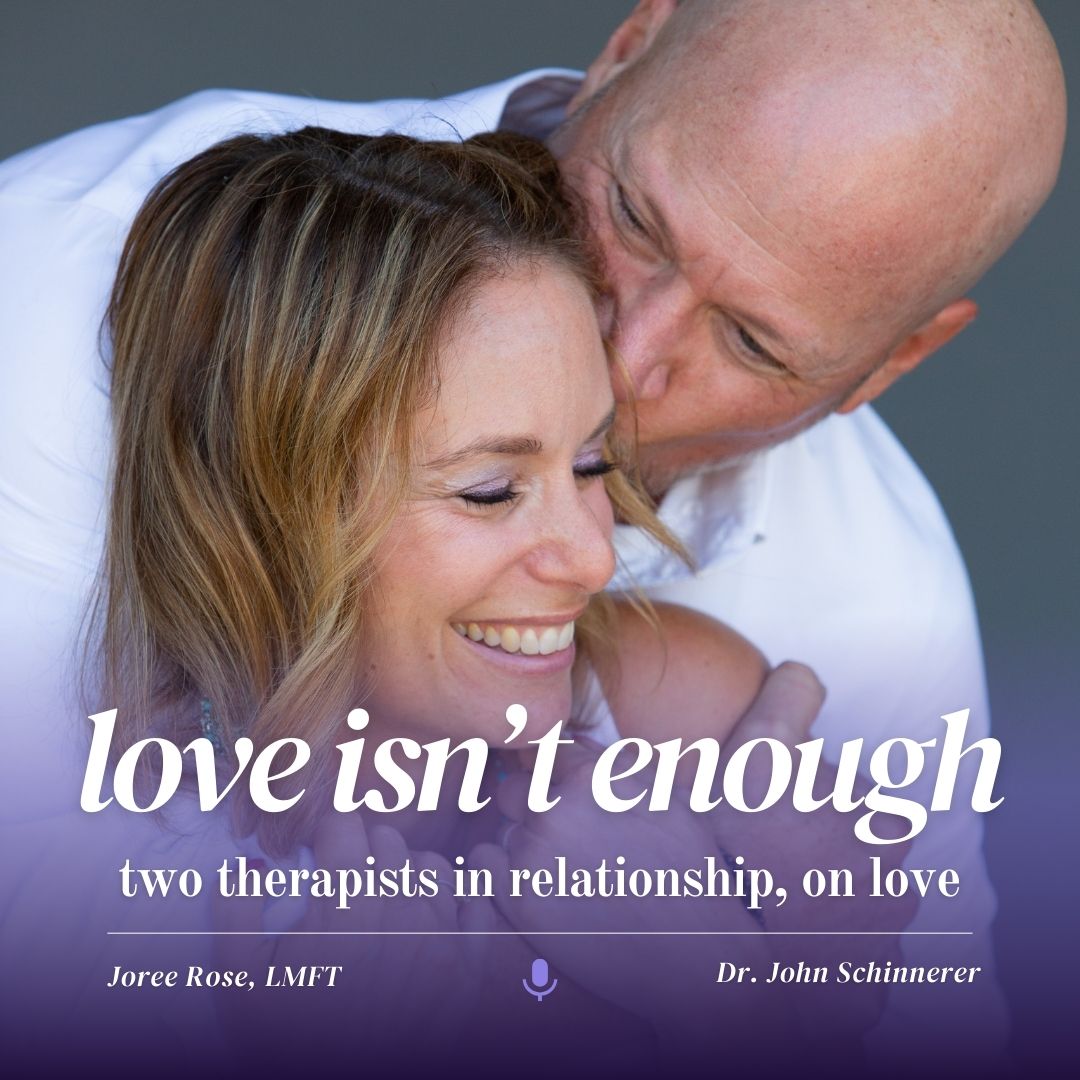
Just days before their wedding, Joree and Dr. John sit down to reflect on how they transformed their insecure attachment styles – hers anxious, his avoidant – into earned secure attachment styles. They share what it looked like to move from fear and defensiveness to trust and safety, and why the work of healing old wounds is the foundation for a lasting relationship.
In this heartfelt conversation, John and Joree open up about what each of them had to face within themselves: John’s struggle with shame and defensiveness, Joree’s fear of losing independence, and how those patterns used to collide. They also talk about the turning points that transformed their relationship, such as the courage to look inward, the commitment to repair quickly, and the practice of listening without defensiveness.
Along the way, they explore the deeper meaning of emotional safety that allows for the ability to be fully seen, to bring anything to your partner without fear of rejection, and to believe in one another’s good intentions. You’ll also hear a fascinating new finding about early friendships shaping adult attachment, why putting the “us” first (per Terry Real) creates two stronger individuals, and how trust and transparency (including access to each other’s phone) becomes a non-issue when safety is real. If you’ve ever wondered whether anxious/avoidant pairs can become secure, this is your playbook, equal parts science, story, and skills.
What You’ll Learn in This Episode, From “Never Again” to “I Do”: How We Healed Our Relationship
-
How an anxious–avoidant couple can become securely attached—and what actually changes when you do the work (less chaos, faster repair, more trust).
-
Why divorce (and relational trauma) can make commitment feel terrifying, even when you love the person you’re with—and how to rebuild trust after “never again.”
-
The hidden reason defensiveness shows up so fast: how shame hijacks conflict, turns feedback into “I’m unworthy,” and triggers shutdown/stonewalling.
-
Non-defensive listening, broken down into real steps: how to validate emotions first, regulate your body in the moment, and save explanations for later (“validation before rationalization”).
-
How the anxious–avoidant trap works in real time: one partner gets hurt → the other gets defensive/shuts down → the anxious partner pursues and abandons their own needs → disconnection grows.
-
The two weekly check-in questions that keep couples close:
-
“What did I do to make you feel loved this week?”
-
“What could I have done to make you feel more loved?”
(And how to keep this from turning into a complaint-fest.)
-
-
How to communicate hard things in a way your partner can actually hear—including the game-changing question:
“If I have feedback, what’s the best way to say it so you can take it in?” -
Joree’s growth edge: healing codependency and fear of “losing herself,” and learning that relationality doesn’t mean self-abandonment.
-
John’s growth edge: building self-worth and learning to trust love again—especially when you don’t feel worthy of it.
-
A powerful “Us” framework from Terry Real: why prioritizing the relationship can create two stronger individuals (and how that changes everything post-divorce, especially with kids).
-
What secure love looks like in real life: trust, transparency, emotional safety, repair within hours (not weeks), protecting the “couple bubble,” and being an actualizer—the partner who helps you become your best self.
-
A surprising insight about attachment: why early friendships can shape attachment patterns just as much (or more) than early caregiving—and why your past still shows up even if your childhood “was fine.”
-
Why Love Isn’t Enough (the whole point of the book): love needs skills—repair, communication, emotional regulation, and a growth mindset—so the relationship can actually thrive.
Connect with Joree & Dr. John and Love Isn’t Enough:
• Website: www.loveisntenough.net
• Instagram: @loveisntenough33
• Subscribe to their podcast: Love Isn’t Enough
• Join our relationship Master Class series: https://loveisntenough.net/masterclass/
Connect with Joree Rose:
• Website: www.joreerose.com
• Instagram: @joreerose
• Subscribe to her podcast: Journey Forward with Joree Rose
• Join the Podcast Membership: https://joreerose.com/journeyforwardpodcast/
Connect with Dr. John Schinnerer:
• Websites: www.GuideToSelf.com | www.TheEvolvedCaveman.com
• Instagram: @theevolvedcaveman
• Subscribe to his podcast: The Evolved Caveman
If this conversation resonated, here are a few ways to go deeper:
• Subscribe to the Love Isn’t Enough podcast
• Leave a review—Scroll down and click Write A Review. It helps more couples find this work
• Join our Monthly Relationship Masterclass on building an emotionally safe and thriving ‘ship
• Work with us directly in couples counseling or coaching. Email (below) to inquire about availability
About Your Hosts:
Dr. John Schinnerer is a psychologist and executive coach out of U.C. Berkeley specializing in emotional intelligence, anger, the evolution of men, and relational health. He has worked with men and couples for over 30 years. He was an expert advisor on the academy award-winning movie, Inside Out. His online anger management class has taught over 25,000 people how to reduce their anger for a happier, calmer life.
Joree Rose, LMFT is a marriage and family therapist focused on emotional safety, attachment, and healing relationship wounds. she has focused on guiding women to greater life satisfaction and purpose and has written several books.
Full Transcript of the episode, From “Never Again” to “I Do”: How We Healed Our Relationship
Dr. John Schinnerer: Hey everybody, this is Dr. John Schinnerer with my lovely fiancé and soon-to-be wife, Joree Rose.
Joree Rose, Online Marriage Therapist: As of the time of this recording, we’re just under three weeks until we get married. However, when this episode comes out, like five days later,
Dr. John Schinnerer: So today we thought that we would discuss a little bit about
Dr. John Schinnerer: How we prepared for this wedding in the sense of how we got to a secure attachment style from, for me, an avoidant attachment style and for Joree, an anxious attachment style.
Joree Rose, LMFT: So we’ve been together almost 10 years and we’ve been engaged for almost six years. And while I was excited to get engaged because calling you my boyfriend really didn’t seem to cut it.
Dr. John Schinnerer: Seems so high school.
Joree Rose, LMFT: It did seem so high school. It didn’t reflect the quality of depth or commitment we had, and yet as happy as I was to say yes to that proposal, I was terrified of actually getting married back then because once you’re divorced, [00:01:00] it’s really easy to be afraid of, oh shit, can this really work?
Joree Rose, LMFT: Again, I know I love this person. I don’t want to be with anybody else but this person. I’m proud to say six years later as we actually prepare for this wedding, not just for the actual wedding, but we prepare for this marriage, I should say, rather, I have no fears, no qualms, no reservations. Because we’ve done the work to create, as you said, that secure attachment.
Dr. John Schinnerer: Yeah.
Dr. John Schinnerer: I remember coming out of my first marriage. There was a lot of trauma there.
Joree Rose, LMFT: Yeah.
Dr. John Schinnerer: There was a lot of damage done. And that happens when you get out of a relationship with someone who is hell-bent on destroying you and your reputation. And so it really damaged my trust in women. Mm-hmm.
Dr. John Schinnerer: I remember thinking to myself, I’m never getting married again. Like, it just doesn’t work.
Joree Rose, Online Marriage Therapist: Yeah.
Dr. John Schinnerer: And so I think one of the things that I really had to work on, but I had some trust issues with women that I had to get past.
Joree Rose, LMFT: So let me ask you this. When you proposed, [00:02:00] were you afraid of marriage at that time? ’cause I was still afraid of marriage at that time, even though I wanted the commitment.
Dr. John Schinnerer: It was a paradox. I was ambivalent at that time. Like I was certain I wanted to be with you.
Dr. John Schinnerer: Yes. I wanted to be in a relationship with you. Yes. I wanted to be exclusive. I didn’t want anyone else forever. Right. Like I said, I was comfortable with that. And yet I think there was still this hesitation about marriage in general, just because it didn’t work out well the first time. Right. It worked out so poorly the first time.
Joree Rose, Online Marriage Therapist: Well, and we see that a lot with our clients who are dating post-divorce, who swear they never need to be married again. Mm-hmm. I think that’s a fairly common sentiment. Again, once the happily ever after is not happily ever after. People really want a long-term partner, but that level of.
Joree Rose, the legality of it, because it’s so hard to get out of that.
Joree Rose, Online Marriage Counselor: But we got to the point of our healing journey where not marrying you didn’t feel right.
Dr. John Schinnerer: Yeah. And I think it became, in my mind, over time, it changed from, I’m never getting [00:03:00] married to.
Dr. John Schinnerer: I’m never getting married until I find the right person.
Joree Rose, Online Marriage Counselor: Mm-hmm.
Dr. John Schinnerer: And then the more we were together, the more I softened to the idea, the more it became, I think I would really like to marry this person.
Joree Rose, LMFT: Yeah.
Dr. John Schinnerer: So it was a gradual shift.
Joree Rose, LMFT: Right.
Joree Rose, Online Couples Counselor: Yeah. Well, sure. A
Joree Rose, LMFT: And I think this speaks to why it is so important for anyone post-divorce or even. In preparation for a long-term relationship. You gotta have the courage to look at your own shit.
Joree Rose, Online Couples Counselor: Because if you don’t, I would put money down and almost guarantee you will repeat the same patterns that you had in the relationship that didn’t work. Or you will attract the same kind of partner that you were used to attracting where you showed up in a similar way. And until you have the courage to look at yourself and your role and your trauma and your pasts, it’s really easy to fall into those old patterns.
Dr. John Schinnerer: I love that idea of, you know, we have to have the courage to look at our own shit in the sense [00:04:00] that I think it’s so easy in relationship to get angry. you get hurt. You get annoyed, it builds to anger, and then we start to externalize blame onto your partner.
Joree Rose, Online Couples Therapist: Mm-hmm.
Dr. John Schinnerer: And then in our mind, it’s a really easy jump to, if they would just stop being such a bitch or if he would just stop being such an asshole.
Joree Rose, LMFT: Or reactive.
Dr. John Schinnerer: The problem with that is it completely cuts me off from. The chance of introspection, of looking at my own self and saying, okay, wait. What do I need to work on to show up better in this relationship? What do I need to work on to heal from my past where I’m bringing wounds into this relationship that likely proceeded even before knowing this person.
Joree Rose, Online Couples Therapist: Yeah. Which was the case for us.
Dr. John Schinnerer: Would say 70% of it.
Joree Rose, LMFT: Yeah, so, you know, we’ve talked about this before. I’m really excited to be at this point of the healing journey where it feels so safe and so secure. It has been a really long time since either one of us got stuck in the old patterns of that anxious avoidant trap.
Joree Rose, Online Couples Therapist: Happens frequently. I don’t want you guys [00:05:00] listening to think that we never have an issue. But what’s different is when we do get disconnected. We repair much faster. It doesn’t linger nearly as long.
Joree Rose, Virtual Couples Therapist: There is no paper cut that is having residue seeping into other areas. I would say the longest it would take to reconnect with would be 24 hours at the longest. But lately it’s, if we’ve got disconnected, it’s within hours. Would you agree?
Dr. John Schinnerer: Yeah, I’d agree.
Joree Rose, LMFT: And part of that is one of the things that we always do is create time.
Joree Rose, LMFT: We really, really prioritize our time together and we find that most couples we work with, it’s hard-pressed to even five, five minutes in a week.
Dr. John Schinnerer: especially if you have kids.
Joree Rose, Virtual Couples Therapist: But those two favorite questions that we used to do quite often that we don’t do as much anymore because it’s so much part of our daily communication and gratitude.
Joree Rose, Virtual Couples Counseling: But the two questions are, what did I do to make you feel loved this week? What could I have done to make you feel more loved this week? Those [00:06:00] simple check-ins allow for. Airing out what might be on your mind, but more importantly, showing gratitude and appreciation for what’s going well.
Dr. John Schinnerer: It is an opportunity to fine-tune things and offer suggestions for, Hey, it would feel better to me if you did this. And I would say take ’em one at a time, like one per week. Right. Don’t. It’s not a laundry list of things that you need to work on.
Joree Rose, LMFT: And those check-ins are really an opportunity to name it and ideally schedule a time to have another conversation about it. We want to keep those check-ins to feel safe, and we also know that from the Gottman’s work, the softened startup is going to be the best way that you can receive your partner’s requests or needs.
Dr. John Schinnerer: Yeah. So let’s talk a little bit about what each of us had to heal in order to get to this point, because I think it’s really illustrative that suggestion that you made about, you know, what can I do to make you feel more loved brings up for me the past where I had to learn to deal with my own shame.
Dr. John Schinnerer: I had to figure out that I was working with [00:07:00] shame. Like I didn’t even know that shame was part of me. It would come up when we would get into a disagreement when usually I had done something where you were like, Hey, can you do this better? And it didn’t matter how kindly or gently you said it, it made me feel all bad. I would go to, I’m unworthy, and then I would get angry. Then I would shut down, which is stonewalling we know that’s not good for the health of a relationship. So,
Joree Rose, Virtual Couples Counseling: and that was kind of some avoidant attachment style behaviors.
Dr. John Schinnerer: Yeah. And what I figured out after some time was, oh my God, like that’s my work.
Dr. John Schinnerer: That has nothing to do with Joree because that pattern has existed almost my whole adult life. And so I had to figure out how do I deal with that? How do I work on it? I did some, you know, IFS internal family systems work to heal that younger child in me. Once I could deal with that shame, then I could get to non-defensive listening, which I think has been a huge game changer for our relationship.
Joree Rose, Virtual Couples Therapy: I wanted to go into a little bit further about non-defensive listening, because this is one of the key [00:08:00] hallmarks that we teach clients and I think is one of the hardest things.
Joree Rose, LMFT: So let’s break that down for a minute because I have to say love you have become incredible at no longer being defensive in this. Thank you. So thank you for that. It’s so much easier said than done, but there’s actually a lot that goes into being good at being non-defensive when your partner’s talking, and then we’ll get to what I had to work on.
Joree Rose, Virtual Couples Therapy: But I think this is really worthwhile.
Dr. John Schinnerer: That’s just one or two areas that I have to work on.
Joree Rose, Virtual Marriage Therapy: Really worthwhile.
Dr. John Schinnerer: Yeah, so non-defense, listening to me is. A, I think you gotta deal with your shame first because it, it was shame that was making it so that I couldn’t listen non-defensively, that I would listen and immediately have to defend myself.
Dr. John Schinnerer: I think that everyone I’ve ever talked to, and I don’t say that lightly, gets defensive when they’re criticized or when they think they’re being criticized. And we wanna explain, even if we’re not getting angry and flying off the handle, even calmly stating, well, this is what I was doing, or this is what I was thinking, or this was my intention, [00:09:00] is still defensive listening because you’re defending your actions.
Dr. John Schinnerer: And I remember realizing that and I was like. Oh shit. Like I thought there was a degree of anger associated with defensive listening. It doesn’t have to be. You can do it really calmly and still be being defensive. And so once I figured that out, I was like, oh. Non-defensive listening is basically, to me, it’s validating how you feel.
Joree Rose, LMFT: Mm-hmm.
Dr. John Schinnerer: It’s listening for the emotion behind the words, and then taking my best guess at how you’re feeling. Because we have to address the feeling first before we can get anywhere.
Joree Rose, Virtual Marriage Therapy: Right?
Dr. John Schinnerer: And so it’s like, Hey honey, I see where this makes you really upset.
Dr. John Schinnerer: I can see where that made you really sad. I can see where that hurt your feelings. Mm-hmm. I’m really sorry. That was not my intention. Right. And then I shut up. Right. And the shutting up is hard also.
Joree Rose, Virtual Marriage Counseling: Mm-hmm.
Dr. John Schinnerer: I literally had to tell myself for a long time.
Dr. John Schinnerer:
Joree Rose, LMFT: Yeah.
Dr. John Schinnerer: In my head.
Joree Rose, Virtual Marriage Counseling: There’s a phrase that I teach clients and it’s validation then rationalization. Because [00:10:00] the validation of someone else’s emotions is going to be where that point of connection lies. It’s the empathy. When we just defend behaviors and rationalize that is nowhere near connection.
Dr. John Schinnerer: Your partner doesn’t feel heard.
Joree Rose, LMFT: No. And we hear from most people. What’s the biggest challenge in your relationship? I don’t feel seen, heard, or validated. I feel dismissed. And there’s another piece, you know, for you to have gotten to non-defense listening was not only identifying that shame, recognizing that you had to not explain, at least in that moment, that could come secondary.
Dr. John Schinnerer: The second conversation, by the way.
Joree Rose, LMFT: There’s a lot of inner coaching going on with your physiology.
Dr. John Schinnerer: Yeah.
Joree Rose, LMFT: And your emotional regulation.
Dr. John Schinnerer: I would tell myself, breathe, relax. It’s important to listen right now; you’re validating her emotion.
Dr. John Schinnerer: This does not mean you’re not worthy, you’re still good. It was largely aimed at calming my physiology, slowing my heart rate, keeping myself as grounded as possible during, you know, when you’re kind of getting upset with me or expressing [00:11:00] a criticism so that I could.
Dr. John Schinnerer: Respond in the best possible way.
Joree Rose, LMFT: Because some of the old patterns, and I want to spell this out too, because I imagine many couples get stuck in this dynamic. Some of those old patterns would be me to come to you and say, Hey, Lev, by the way, what you just said hurt my feelings. And you would get defensive. Which then made you angry, which, like you said, you would then shut down and withdraw. And because that was an avoidant pattern, it kicked in my anxious pattern in which I would pursue to rescue you out of your shame. And I would work hard to make you feel better.
Joree Rose, LMFT: About my feelings being hurt, and then I would really work to regulate your mood to the point of abandoning my initial statement of, Hey, my feelings were hurt.
Dr. John Schinnerer: Well, and that pattern’s really dangerous in the sense of it trains you to no longer speak up for what you need.
Dr. John Schinnerer: And that’s the real heart of the matter there.
Joree Rose, LMFT: Yeah, so once you were able to do [00:12:00] that, and I felt seen, we were able to stay much more connected even during conflict. And it was amazing. And it was funny because I had assumed I was much better at being non-defensive in my listening.
Joree Rose, LMFT: And once you got better at it, it highlighted, oh damn it. I’m not as good as this as he is, and I thought, and before that I was one better at it, but by comparison, maybe I was, but you got better at it first. And then I had to really work on, oh God, I hate letting him down.
Joree Rose, LMFT: Yeah. ‘
Joree Rose, LMFT: Because you know, as soon as you say something that I did that hurt your feelings, my immediate response is, that’s not what I meant. I didn’t intend to hurt you, and that’s not the point. Ideally, you never intend to hurt your partner. So when you would then come to me, I’m like, ah, shit, I did it too. God damnit. I just hated that.
Dr. John Schinnerer: Well, and I think you’re touching on something that is also a heart of the matter and, [00:13:00] if you don’t like swearing, turn the volume down for a second because I’m gonna swear, but I fucking hate.
Dr. John Schinnerer: To disappoint you, to hurt you, to let you down. And once I realized that and that that was at the core of me going to shame or me feeling unworthy or me shutting down, it was easier to go after it. And the funny thing is, is since then we’ve talked to a lot of couples and I think a lot of us are exactly the same way.
Dr. John Schinnerer: And it really helps to understand just how much we hate to disappoint our partner.
Joree Rose, LMFT: Yeah.
Dr. John Schinnerer: And so if we can understand that and you can understand that your partner feels that way and they’re trying as best they can not to do that, I think it really helps us to stay with assuming positive intent.
Dr. John Schinnerer: Now we can be in a disagreement or disconnected and I’m a hundred percent solid. Understanding your intentions are always positive.
Joree Rose, LMFT: Yeah.
Joree Rose, LMFT: Because in the past I think I would get hurt or angry and that would falter. Well, and that was based on your past. Which you had to overcome [00:14:00] that trust.
Dr. John Schinnerer: Yeah.
Joree Rose, LMFT: Taken advantage of dubious intentions. Right, right. So I can’t overemphasize the non-defensive listening enough. And I think one of the barriers there is kind of like love languages where we tend to.
Joree Rose, LMFT: Give our partner what we most need. We’ve gotta understand how we can speak so our partner can best listen, not how we would best want it back. So I always invite our clients that we work with our couples to ask, “ Hey, if I’ve got some feedback for you, if I’ve gotta share something of what you’ve done that might’ve hurt my feelings, or where I’m not really feeling safe or secure, what is the best way I could say it so that you could best hear it?”
Dr. John Schinnerer: And I love that advice because it interrupts the dynamic in the sense of, “If I tell you. What I think is the best way for you to communicate with me when you have a concern or a criticism, and then you use that form of language to communicate that to me later. And I still get activated and triggered and go to shame.”
Dr. John Schinnerer: It points out that “ That’s my shit. That’s your work. That’s [00:15:00] my issue. And I love the clarity that we got of what’s my issue? What’s your issue and what’s a relational or an US issue? Because when you have clarity on that, it really helps in terms of what do I need to work on and how do I need to go about working on it?”
Joree Rose, LMFT: To go from an insecure to a secure partnership.
Dr. John Schinnerer: Well, that’s a good segue for you.
Joree Rose, LMFT: It is.
Dr. John Schinnerer: No, I’m just teeing it up for you.
Joree Rose, LMFT: Thank you. So what I had to work on in this relationship, having come from an enmeshed family of origin and codependency in my marriage, I mean, I was with my ex-husband since I was 13 years old. So once I got divorced and I was finally feeling like a whole person on my own, I was terrified of getting lost in a relationship, losing myself, losing that independence that I worked so hard to gain that I was so proud of, and it interfered with what is relationality versus independence, and my sense of [00:16:00] pride around independence, lo and behold, was really hurting John, and I couldn’t hear that at first because I wanted him to be supportive of my growth, supportive of my individuality until it got to a point where it was quite hard.
Joree Rose, LMFT: And you saw where I was coming from and I had to really look at, can I hear him authentically and not see that that’s.
Joree Rose, LMFT: Is not him trying to squash my light. ’cause that was how I interpreted it from my past. I mean, one of the things that we talk about is how protective we are of each other’s energy.
Joree Rose, LMFT: And I’m always looking out for John’s energy, whether it’s taking a nap, not overworking himself, the energy of the people he’s around.
Joree Rose, LMFT: It’s a little bit self-serving. ’cause the more his energy is protected, the best version of him I’ll get. Right. So, I mean, it’s okay to be self-serving and looking out for your partner, and it’s also for your best intentions.
Joree Rose, LMFT: And John would look out for me, but my interpretation was dubious in the sense that I thought it meant you didn’t support [00:17:00] my individual ventures or growth business wise, or my, you know, yeah.
Joree Rose, LMFT: My individual needs in that capacity, because that was my old wound. And there was this one story where he put a post-it note on my bathroom mirror that said, “Slow down.” I can see now how that was such a loving act to support my energy, prevent me from over-functioning and overdoing to help me get good rest.
Joree Rose, LMFT: But at the time, I made him take it down because I felt offended.
Dr. John Schinnerer: You’re squashing my light.
Joree Rose, LMFT: You’re squashing my light. And so I had to look at how I was misinterpreting. His emotions, his needs, his requests, and his hurt. And realize, oh, relationality does not mean losing yourself.
Joree Rose, LMFT:
Dr. John Schinnerer: Tell that story about Terry Real.
Joree Rose, LMFT: Yeah.
Joree Rose, LMFT: I had the honor of not only interviewing Terry Real, on my podcast journey forward with Joree Rose, but John and I met Terry at a conference a couple years ago, and if you don’t know Terry Real’s work, highly recommend checking him [00:18:00] out.
Joree Rose, LMFT: His most recent book is called “Us.” He does relational couples therapy. Brilliant therapist. And we met him at a conference a few years ago, right after we had just gotten back together from our breakup. And, you know, it was actually kind of cool because he had told John, “I had courage.”
Dr. John Schinnerer: Well, you told him that we had broken up and just got back together, and he said, “Congratulations on the courage for breaking up and congratulations on having more courage to get back together.”
Joree Rose, LMFT: But I had asked him because his book is titled “Us,” and it’s kind of this individual versus relationality conflict. Many couples get stuck in it. I said, “You know, how do you know the right balance?” And he said, “If you focus on two individuals, that’s never going to strengthen the ‘Us.’ But if you put the relationship first and focus on the ‘Us,’ that can really give a foundation for two strong individuals.”
Joree Rose, LMFT: And that insight at that particular time in our relationship too, where I knew. I need to look at what do I need to do [00:19:00] differently to give John the safety and security he needs, just like he was working towards giving me safety, security. That was a big shift for me.
Dr. John Schinnerer: To what extent do you think that you’ve put the relationship number one since the breakup?
Joree Rose, LMFT: A hundred percent.
Dr. John Schinnerer: And I think it’s a difficult question in the sense of, I think we had to put us number two. After our kids, which we talked about. Because I think you have to do that in a post-divorce situation where you absolutely have kids.
Dr. John Schinnerer:
Joree Rose, LMFT: Right?
Dr. John Schinnerer: And then there was a point at which, okay, now the kids are old enough, let’s elevate us to number one.
Joree Rose, LMFT: And I actually think that’s been beneficial in creating really healthy boundaries with my adult daughters.
Joree Rose, LMFT: And more importantly.
Joree Rose, LMFT: We talk about this a lot, how our relationship, our healing of our own relationship has set a role model for our girls and what their relationships look like. And that’s been huge.
Joree Rose, LMFT: But one of the things that we hold a lot of value around is that our daughters, who are, two of them are 19, 1 is 22.
Joree Rose, LMFT: They got to [00:20:00] see us fight for this relationship. They got to see what it takes to put the work in. They got to see what it means when you love someone and you don’t wanna let them go and you’ve got to look at yourself. And I love that. Like they got that role modeled.
Joree Rose, LMFT: Yeah.
Joree Rose, LMFT: And you know, one of the things that you have taught these young women is to know your worth.
Joree Rose, Relationship Podcast Host And that is because I think we also fought for our worth. So it’s not compromising your worth, your needs, your values. It’s looking for the partner who is going to strengthen that to honor that, to believe in that.
Dr. John Schinnerer: One of the things that I had to work on in this relationship in order to get to where we are was a belief in my own self-worth.
Dr. John Schinnerer: Part of the problem I had with trusting Joree fully is I didn’t believe I was worthy of the degree of love that she was showering upon me. I see this in so many people. I think everyone at some point in time struggles with self-worth.
Dr. John Schinnerer: And you know, to me, self-worth is different from self-esteem. They’re both how you [00:21:00] feel about yourself globally. But self-esteem is how you feel about yourself globally based on external validation. So, accomplishments, achievements. The number of likes you get on Facebook or Instagram or whatever, and that’s fraught with peril.
Dr. John Schinnerer: it’s inconsistent. And if you do well, your self esteem’s high. If you do poorly or you make a mistake, your self-esteem goes in the toilet. Self-worth on the other hand, is how you feel about yourself globally based on internal validation, based on your highest values, based on your deep understanding that you are worthy regardless.
Dr. John Schinnerer: Of how you do or if you do. And you know, there, there’s ways to work on increasing that self-worth, which I won’t go into now, but I think check out
Joree Rose, Relationship Podcast Host John’s podcast, the evolved caveman.
Dr. John Schinnerer: I think if you want a happy, satisfying, and secure. Relationship because one of the biggest barriers we see in couples is one or both people simply don’t believe they’re worthy of the love of their partner. ideally, your partner sees you in the best [00:22:00] possible light or in a really good light, and the goal is for you to catch up.
Dr. John Schinnerer: To how your partner sees you.
Joree Rose, Relationship Podcast Host Mm-hmm.
Dr. John Schinnerer: And so I just wanted to bring that up in terms of I think I realized that first and then realized, like the girls need to know this as well. This is critical for everyone, right? To really get under their belt that they need to know. We need to know, everyone needs to know you are worthy simply for.
Dr. John Schinnerer: Simply by virtue of the fact of breathing. That you exist, that you were born, you don’t need to do anything to be worthy. You just need to remember that you’re worthy.
Joree Rose, Marriage Counselor Danville CA: Yeah. My oldest daughter ended a short relationship and when she called us and told us, the first thing she said was, “Mom, I know my worth.”
Dr. John Schinnerer: And we did a little dance.
Joree Rose, Marriage Counselor Danville CA: Did a little Happy Dance. High five. ‘Cause imagine the quality of relationships that people could have if they inherently knew their worth, and how many people would not stay too long in a relationship in which their worth was questioned or squashed.
Joree Rose, LMFT: We see people who [00:23:00] get into a relationship quickly and then take forever to get out of it. And that’s so unfortunate and you know it’s interesting where it’s not your partner’s job to heal your own wounds, but your partner’s love can be a model for which your wounds can be honored and their inherent love can be healing.
Joree Rose, LMFT: I still have to do my own work, but John loving and supporting and helping me see the best in me. Helped me heal my wounds of insecurity and anxiety and lower worth. And I even said to you last night that I am, so proud at this stage of my life because I’ve had more self-love than I’ve ever had.
Dr. John Schinnerer: Yeah.
Joree Rose, Marriage Counselor Danville CA: And that is a reflection of our healing journey, where we’ve looked at where are my wounds and how have those wounds interpreted my sense of self.
Dr. John Schinnerer: Yeah. And I think part of that, to dovetail on that is. We encourage clients a lot too. Practice speaking to each other as gently as possible.
Dr. John Schinnerer: [00:24:00] particularly around difficult, sensitive topics, which a lot of them are. And you know, so it really takes some practice to think, how can I phrase this as kindly as possible? What’s my tone of voice? How am I coming at this? Am I coming at this at a time when they can best hear me?
Joree Rose, LMFT: Mm-hmm.
Dr. John Schinnerer: A lot of these things do trigger shame or self-worth issues or insecurities, and yet, if we are at our best, when we’re at our best, we can help our partner to heal. It’s not my responsibility to heal Jo. I just wanna give her the best conditions in which to do that.
Joree Rose, Marriage Counselor San Ramon CA: Yeah. It’s pretty exciting that we get to get married so soon and right before we met 11 days to be exact, I wrote a letter titled Dear Future Partner, and at the top of that, I had the quote that I recently had found by Rumi that says, what you seek is seeking you.
Joree Rose, LMFT: And that changed my entire perspective on dating. That I wasn’t just looking for someone, but someone was looking for me. [00:25:00] And I was very clear in what I was grateful for, what I was open for, what I specifically wanted. It is specific what I was looking for in a partner, and then I just released it and filed that piece of paper in my file cabinet and 11 days later I met John.
Joree Rose, Marriage Counselor San Ramon CA: Well, we were recently working on our vows and I pulled out that letter that by the day we get married, it will be one week shy of exactly 10 years that I wrote that letter. And I’m actually gonna read it at our wedding because what I wrote 11 days before we first met is exactly the relationship we now have.
Joree Rose, Marriage Counselor Walnut Creek CA: I mean, there was so much synchronicity that aligned in that meeting. Having the clarity of what you’re looking for and who you are and what you seek is seeking you and knowing what you don’t want to repeat is a path to getting there.
Joree Rose, LMFT: So it’s, it’s encouraging and I, I hope that you listening, if you [00:26:00] are looking for that long-term partner or post-divorce or first time around, do your own work because that will set you up for the healthiest relationship possible. You know, we see so many couples.
Joree Rose, Marriage Counselor Walnut Creek CA: They’re simply just stuck in patterns that are interfering with their view of one another, their acceptance of one another, or their belief in the relationship. And I mean, yes, our whole brand is love isn’t enough. And this is why, because unless you look at yourself, do the healing work, identify what’s creating the negative patterns, and have the courage to look at all of it, you really can’t.
Joree Rose, Marriage Counselor Pleasanton CA: Have the love you’re seeking. It is a hundred percent possible if you have a willing partner who’s willing to do the work with you. Weed that out early on.
Dr. John Schinnerer: Well, yeah, I think to me, one of the most important things to look for in a potential partner is someone who has a growth mindset around relationship skills.
Dr. John Schinnerer: So find someone that’s willing to grow with you and learn new ways to show up and be better. In your relationship.
Joree Rose, LMFT: Yeah.
Joree Rose, Marriage Counselor Pleasanton CA: So there’s one last thing [00:27:00] that I wanted to share in this episode because so much of what we talked about was our attachment style patterns. I was anxious, John was avoidant. We’ve developed that secure, safe attachment.
Joree Rose, Marriage Counselor Oakland CA: But you recently read a study. About attachment that I think is so fascinating because the more and more we’ve done couples work, the more and more we’ve realized just how critical understanding your attachment wounds and your subsequent attachment styles based on those core wounds, how critical they are in seeing how you show up in your relationship.
Joree Rose, LMFT: Generally during conflict in your relationship.
Dr. John Schinnerer: Yeah. Thank you for reminding me. There was a study done recently, and it had over a thousand participants. It followed people from zero to two years of age, and it’s followed them for over 30 years. Now there’s like, I don’t know, 750 participants that they could track down, but they had their attachment styles.
Dr. John Schinnerer: Now they’re looking at what’s the impact of. Those attachment styles in the romantic relationships. one of the things they found, which is fascinating, is they found [00:28:00] most of these people, they were looking at mothers as the primary caregiver that influenced attachment style because back 30 years ago, fathers weren’t typically the primary caregiver.
Dr. John Schinnerer: So we don’t have data on how fathers affect attachment styles as the primary caregiver. However, the thing that was so fascinating to me was. Yes, yes, your relationship with your mother early on can set your attachment style. By the way, that attachment style is malleable. It can change relationship to relationship.
Dr. John Schinnerer: It can change month to month, which fascinated me. But the bigger takeaway, the thing that really caught my eye, is that your early friendships actually can affect your attachment style more so. Then your relationship with your mom, which is interesting because now it kind of is an either or. So it could have been your mom that sets your attachment style or your early friendships, which makes a lot of sense.
Dr. John Schinnerer: For some of the people that we look at. ’cause we’re like, oh, she had a really, like her mom was there, she was present, she was emotionally available. Like why [00:29:00] does she have an anxious attachment? Oh. Because she really struggled with friends. When she was really young. makes so much sense now.
Joree Rose, Marriage Counselor Oakland CA: Did they give an age range for that? Timing of those early friendships, curious? No, they didn’t.
Dr. John Schinnerer: Assuming, you know, four to eight.
Joree Rose, Marriage Counselor Berkeley CA: I would think elementary age.
Dr. John Schinnerer: But I would think elementary school, yeah, it’s childhood, right? It’s not middle school, it’s not high school.
Dr. John Schinnerer: Right. It’s those first friendships,
Joree Rose, LMFT: those first formative years.
Dr. John Schinnerer: I was stunned.
Joree Rose, Marriage Counselor Berkeley CA: Yeah. And again, another reminder of looking at how our past affects our present. And if you don’t think your past affects your present. We haven’t looked hard enough.
Joree Rose, Marriage Counselor San Francisco CA: We can still have had great childhoods and still have an impact on how things show up in adulthood. It doesn’t have to be trauma. But we can have difficult experiences that may make us self-protective, not trust others, not feel safe in conversation.
Joree Rose, LMFT: I mean, how many couples do we work with who simply don’t know how to talk about sex? They don’t know how to talk about how to get on the same page of parenting. They don’t know how to talk about their emotions, their needs, like we are not. [00:30:00] Socialized or primed for this. So we, if you want this level of relationship, I don’t like to say it takes work because work has a negative connotation, and yet what it does take is time and energy. Yeah. And focus, awareness, and desire. If you don’t want a deeply connected relationship, you’re fine not looking at this. But if you do want one in which you can bring anything to the table, have such safety and security. We were also just talking recently about another hallmark of that safety and security is having access to your partner’s phone.
Joree Rose, Marriage Counselor San Francisco CA: And when you’ve got nothing to hide, you have full trust and transparency. There’s no reason not to give your partner your password. And we have such, such safety and trust with one another. There is no problem. Hey, love, check my phone, look at my calendar, look at this text.
Joree Rose, Marriage Counselor Dublin CA:
Dr. John Schinnerer: Interesting thing we’re talking about after that is that because we have the trust and safety, if I had an issue, if I had a suspicion, if I had a doubt, I would come to you first, right? And say, “ Hey, can we talk about this?”
Dr. John Schinnerer: I wouldn’t go to your phone [00:31:00] and look at your phone behind your back, because that in and of itself is a violation of trust.
Joree Rose, LMFT: Even though you had full access. Yeah. So it’s an interesting dynamic, but I just wanna highlight that because we keep looking at what are these hallmarks of a secure relationship.
Joree Rose, Marriage Counselor Dublin CA: Because I do believe, as we’ve said before. Security and safety is the goal because then you can bring up anything without fear of rejection or disconnection. Well,
Dr. John Schinnerer: And briefly before we wrap up, let’s just rattle off a couple of the things that a secure relationship gives you, because immediately off the top of my head is 110% trust.
Dr. John Schinnerer: For me, it’s looking out for each other, being protective of one another. Being protective of the couple-ness, the couple-dom.
Joree Rose, Marriage Therapist Dublin CA: The couple bubble.
Dr. John Schinnerer: Yeah.
Joree Rose, LMFT: I could see you kind of skirting around it. Yeah, I think there’s safety in bringing up emotion that my emotion will be acknowledged.
Joree Rose, Marriage Therapist Pleasanton CA: Mm-hmm. Being heard. Yeah. That
Joree Rose, Marriage Therapist Pleasanton CA: I’m not silly or stupid for feeling what I feel because back to that, you know, validation before rationalization, many couples get stuck on. Why were you angry about that?
Dr. John Schinnerer: Which is just a way to shut down emotion in my mind.
Joree Rose, LMFT: Yeah. So when you have that security, you know that your needs, your emotions, your thoughts matter to your partner.
Dr. John Schinnerer: Yeah. And I think you also know that your partner is working as hard as you are to repair as quickly as you. The repairs come more quickly, the disconnects come less frequently.
Joree Rose, Marriage Therapist San Ramon CA: Yeah. And I would also say those who have security, they are going to prioritize the relationship, time, energy, and attention.
Joree Rose, Marriage Therapist San Ramon CA: Yeah. Whether that’s date nights, prioritizing sex, intimacy, making sure we have those check-ins and that we feel safe to bring up whatever’s on our mind, that is, it’s gold.
Dr. John Schinnerer: You know, having a partner that builds you up to be the best possible version of yourself.
Dr. John Schinnerer: That we encourage each other, we cheerlead for each other, we’re always kind of championing each other. And that’s so critical to me. Because we see so many couples where it’s the opposite.
Joree Rose, LMFT: Right.
Dr. John Schinnerer: You’re getting criticized, you’re getting belittled.
Joree Rose, Marriage Therapist Danville CA: We recently saw Dr. Lindsay Gibson speak check out the book Adult Children of Emotionally Immature Parents. It is brilliant, instant classic, brilliant, brilliant book and what she talks about our emotionally immature parents are.
Joree Rose, Marriage Therapist Danville CA: Not looking out for the best growth and actualization of their child. She actually differentiated: Terminators versus actualizers. Actualizers are people who are going to want to build you up to be the best version of yourself. Terminators shut that part of you down and squash it for their own issues.
Joree Rose, LMFT: Anxiety, insecurity, fear, whatever you know, is their emotional immaturity. And as partners, because she was talking about it as therapists and parents. And I would argue as partners, you would want to help your partner self-actualize, which means help them become the best version of who they’re meant to be based on their soul’s intention, purpose, and what they’re here to do in this life.
Joree Rose, LMFT: And that is a goal that is a hallmark of secure love.
Joree Rose, Marriage Therapist Danville CA: So I can’t wait to marry you. I’m so [00:34:00] excited.
Dr. John Schinnerer: I’m really looking forward to it.
Joree Rose, Marriage Therapist Walnut Creek CA: It’s going to be a great day.
Joree Rose, Marriage Therapist Walnut Creek CA: And we are actually taking the month of December off, so this is our last episode of the year.
Joree Rose, LMFT: Thank you so much for being a listener of the Love Isn’t Enough Podcast. And we will be excited to be back in the new year. We’ll come on and maybe we’ll have our first episode sharing all about our wedding. I’m really proud of this relationship, and I’m really proud to be a role model for what relationships can look like because I fell in love with you practically the day I met you.
Joree Rose, Online Marriage Therapist: And we fought hard to get to where we are. So I really hope that this can be a role model that if you are in a similar boat, you can get there as well.
Dr. John Schinnerer: So thank you so much for your time and attention.