
Episode 10 – Let’s Talk About Sex: Breaking The Silence In ‘Ships
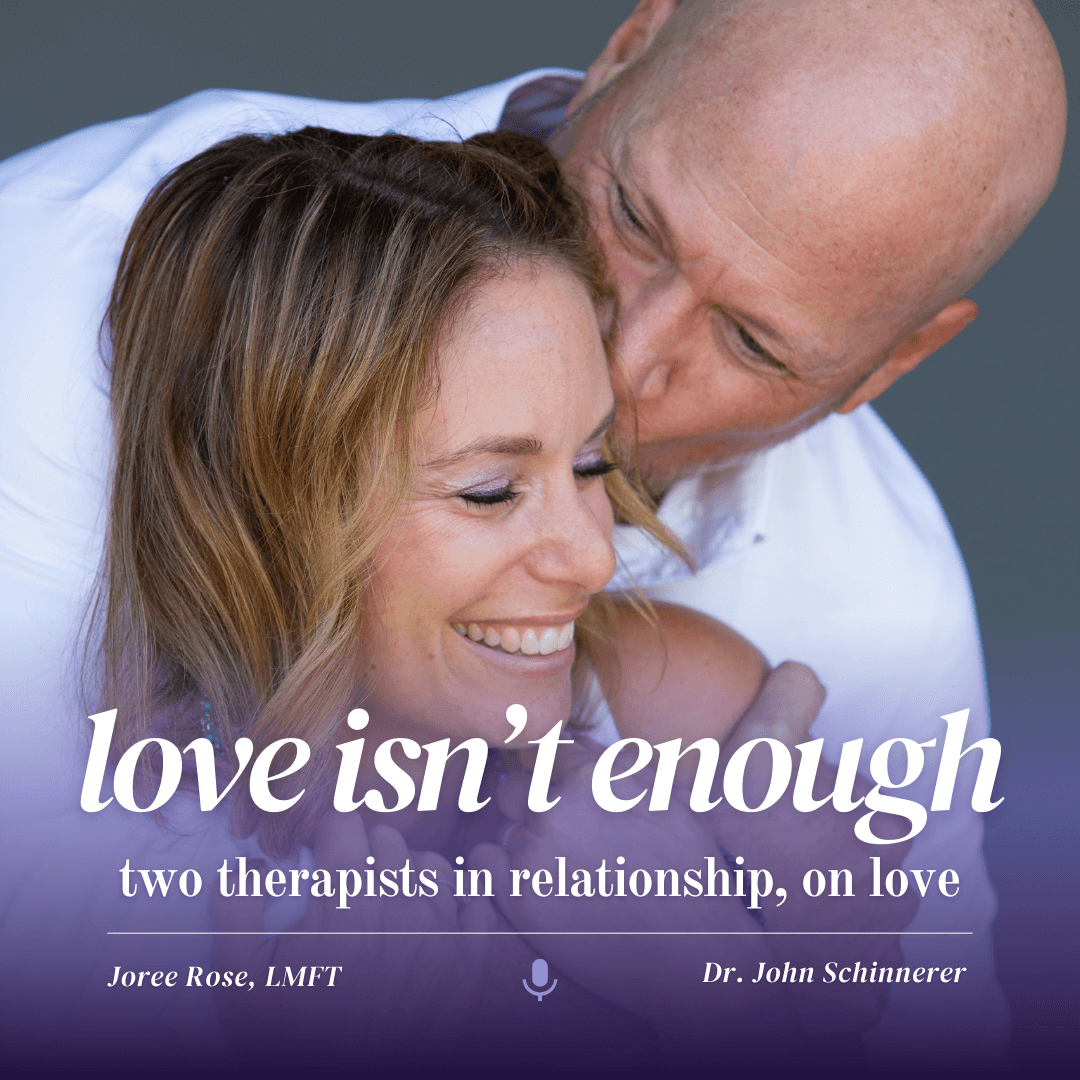
Sex is one of the most important aspects of a relationship—and yet, for so many couples, it’s one of the hardest topics to talk about. In this episode of Love Isn’t Enough, Dr. John Schinnerer and Joree Rose dive deep into the reasons why couples struggle to communicate about sex, the unspoken beliefs and fears that keep them silent, and how they can start having more open, honest, and fulfilling conversations about intimacy.
In this titillating episode, Dr.John and Joree explore:
• The common reasons couples avoid talking about sex (and how this creates distance).
• How cultural conditioning, shame, and past experiences shape our ability to communicate about intimacy.
• The difference between desire, arousal, and connection—and why understanding this matters.
• Practical ways to bring up sex in a way that feels safe, nonjudgmental, and productive.
• Tools to deepen emotional and physical intimacy through open, honest dialogue.
If you and your partner struggle to talk about sex—or if you want to improve the way you communicate about your needs and desires—this episode is for you!
Connect with Joree & Dr. John and Love Isn’t Enough:
• Website: www.loveisntenough.net
• Instagram: @loveisntenough33
• Subscribe to their podcast: Love Isn’t Enough
• Join our relationship Master Class series: https://loveisntenough.net/masterclass/
Connect with Dr. John Schinnerer:
• Websites: www.guidetoself.com | www.TheEvolvedCaveman.com
• Instagram: @theevolvedcaveman
• Subscribe to his podcast: The Evolved Caveman
Connect with Joree Rose, LMFT:
• Website: www.joreerose.com
• Instagram: @joreerose
• Subscribe to her podcast: Journey Forward with Joree Rose
• Join the Podcast Membership: https://joreerose.com/journeyforwardpodcast/
If you and your partner struggle to talk about sex—or if you want to improve the way you communicate about your needs and desires—this episode is for you!
Lets Talk About Sex: The Taboo Topic in Relationship – Transcript
Setting the Stage:
Dr. John Schinnerer: Hey everybody. This is Dr. John back with my partner in life and love Joree Rose, and today on love isn’t enough. We are titillated to be talking about sex. What goes into a fantastic sex life.
Joree Rose, LMFT: I what goes into, just took my image in my head somewhere. John, we know what goes in where. We’re not giving some basics on sex.
Dr. John Schinnerer: Do we? Do we do. We do. They can’t make assumptions.
Joree Rose: And then I also have the thought in my head from that song, let’s talk about sex, baby. Oh,
Dr. John Schinnerer: always.
Joree Rose: Yeah. Anyhow. Oh, we’ll just leave that sound. The sound effects in the background.
Dr. John Schinnerer: Yeah.
Joree Rose: So back to focus.
The Importance of Talking About Sex
Joree Rose, LMFT: I love talking about sex. I know you do. I know you do that.
Joree Rose, LMFT: I know that. You know, I know. But what I love [00:01:00] talking about it because couples don’t. Mm-hmm. And it’s such a fascinating conversation to bring to the table or to the bedroom to be able to understand a little bit more of. As you so visually put it, what goes into it.
Dr. John Schinnerer: Yes. Well, and I mean, just what keeps us from talking about sex, I think how we’re brought up, right?
Dr. John Schinnerer: That there’s shame, there’s embarrassment involved, and a lot of the people that I’ve talked to in the past and and myself included for many years in my life, we’re embarrassed to even say the words. Yeah. With our partner. Well, and if you can’t say the words, how are you gonna talk about? What you want, what would feel better?
Naming Body Parts and Overcoming Shame
Joree Rose, LMFT: I remember my sister tells a story of, of someone she knew in high school who would go around it and whisper in people’s ears, “vagina,” because it’s funny because we don’t say the words right? We don’t say the words of body parts, right? We don’t. We have nicknames that either are crude or depersonalized, and [00:02:00] I mean, right off the bat, this is something for couples to consider is how do we name each other’s body parts?
Joree Rose, LMFT: Mm-hmm. Do we agree on that? And is it uncomfortable to say that? Do we have to be formal?
Dr. John Schinnerer: Well, and does what I call it make you laugh or make you feel like it’s not sexy? Tits, boobs, boobies, breasts. I don’t
Joree Rose, LMFT: like breasts. Breasts remind me of chicken.
Dr. John Schinnerer: Yeah. And, and so I don’t like
Joree Rose, LMFT: breasts. Thank you for never using that word.
Joree Rose, LMFT: It’s, it’s interesting
Dr. John Schinnerer: because I think we have to agree on a common language where neither one of us have this ick association with it.
Joree Rose, LMFT: Well, and it’s not just the ick. Personally, but sometimes a lot of the words can be derogatory. Right? Don’t be such a pussy.
Dr. John Schinnerer: Mm.
Joree Rose, LMFT: Right. Or you know, obviously there’s, there’s other harsher words, the C word.
Joree Rose, LMFT: See you next Tuesday as you, you know, we, we’ll sometimes refer to difficult people,
Dr. John Schinnerer: but I think, I think we should really reclaim pussy. And I think for so long it was used as an insult, right? And yet it’s really this amazing body part in females that shows incredible resilience, incredible flexibility, incredible strength,
Joree Rose, LMFT: uh, empowerment.
Dr. John Schinnerer: Yeah, it, it’s, I don’t understand ever why it was an insult other than, you know, I think men wanted to dominate women.
Joree Rose, LMFT: Well, isn’t that still the case of so many men? Unfortunately.
Dr. John Schinnerer: Uh, mm-hmm. So,
Joree Rose, LMFT: where do you wanna begin?
Building Intimacy Throughout the Day
Dr. John Schinnerer: I, let’s, let’s start about, let’s start at the, at the beginning, like the beginning of the day, so to speak, or the laying the groundwork for sort of what leads to great sex.
Dr. John Schinnerer: And, and the reason I think start there is because I don’t think a lot of men think of that. I think they think of it more short term.
Joree Rose, LMFT: I’m gonna say women too, not just men. Okay,
Dr. John Schinnerer: fair enough. but I, I think that, you know, one of the things that we always share is that the brain is the biggest sex organ in the woman’s body.
Dr. John Schinnerer: Mm-hmm. And, and so to me that’s a helpful reframe in terms of if I want to have sex with my partner, I need to be. Sort of [00:04:00] laying the groundwork for that all day long, by flirtatious texts, by doing kind deeds, by compliments, by showing appreciation and gratitude. Like to me, those were all the ways to get her brain in the mood.
Joree Rose, LMFT: And there’s a lot of things that even if you were to do those, might still prevent. The brain might still have things that are preventing you or the woman from holding onto those kind acts and turning toward if there’s unresolved issues. Mm-hmm. If there’s a buildup of resentment, if there’s unaddressed paper cuts that are still open wounds, whether they’re really teeny tiny or whether they’re bigger.
Addressing Barriers to Intimacy
Joree Rose, LMFT: Because I think if we don’t address what are the barriers in specifically a woman’s brain from allowing herself to literally. Open herself up mentally, physically, emotionally, spiritually. Right? That that’s where I think it’s, it’s really important to recognize, and I agree a hundred percent. Sex starts the [00:05:00] beginning of the day.
Joree Rose, LMFT: You know, I, I still always love that example that Abby Wombat gives with Glennon Doyle of, for her sex is when Glennon brings her coffee in the morning.
Dr. John Schinnerer: I think it was intimacy. Yeah. But it is intimacy.
Joree Rose, LMFT: But that they defined sex as intimacy and that was one of the ways that was most intimate. And
Dr. John Schinnerer: because only she knows how the other, her partner likes her coffee
Joree Rose, LMFT: and she’s the only person who gets to do that.
Dr. John Schinnerer: Yeah.
Joree Rose, LMFT: So it’s an intimate act, but if you do all these kind and intimate and loving, desirous acts towards me all day. And I still have unaddressed or unresolved wounds or paper cuts, it’s not gonna be really easy. Mm-hmm. To even receive those things of kindness. ’cause we see this, right? I mean, we work with a lot of couples, we work with individually, men and women, and we see those patterns and where there’s a lot of kind acts being done that aren’t received, which then gets into this negative cycle of rejection of, you didn’t even receive this as something kind.
Joree Rose, LMFT: Not knowing of what the barriers were to receiving. [00:06:00] And then eventually those kind acts slow down, they stop, person feels rejected. I mean, it’s a constant cycle we see. Right?
Dr. John Schinnerer: Yeah. And, and I think, you know, you mentioned paper cuts and I think that the paper cuts is a big part of this that. It’s those paper cuts that are the small hurts, annoyances, resentments that build up and accumulate over time, and that we don’t address.
Dr. John Schinnerer: Mm-hmm. That we, we just aren’t very good at addressing and repairing. And so as a result, what happens is our perception of our partner goes from all or mostly positive to all, or mostly negative. And then it, it affects how we interpret the other person’s acts and intentions. Right. And, and we’ve seen it get so bad that you can do a kind act.
Dr. John Schinnerer: Someone does a kind act for their partner. It’s interpreted completely through a negative lens, and at that point you, you know, you’re not getting lucky tonight. Right. In fact, we’re, you know, in in those cases it’s, it might’ve been years since they’ve been intimate.
Joree Rose, LMFT: Right. And we’ve seen the whole gamut.
Joree Rose, LMFT: Of, of [00:07:00] frequency, of intimacy, and I think this is a, I mean, I think today’s conversation is gonna jump all over the board. Mm-hmm. Right? Because I think there’s a lot of components that go into it. So starting with the how do we even prime our brains and our bodies for being open to it. We recently saw something I shared with you, I forget now, where I saw it, it was a post or something that instead of asking the question, are you gonna be available for sex tonight?
Joree Rose, LMFT: It was more like, are you willing, oh, how did that go? Do you remember when I was, what I, what I shared with you? It was like, are you willing to be open, open
Dr. John Schinnerer: to become more aroused? I something that to become more arou, something like,
Joree Rose, LMFT: right, because I think what they, your
Dr. John Schinnerer: arousal level,
Joree Rose, LMFT: I think what it was highlighting is, especially for women, it takes a long time for that arousal to go from non aroused to an arousal state that they feel ready.
Joree Rose, LMFT: For, for sex. Well,
Dr. John Schinnerer: and I think some of the research that we’ve read shows that for men it’s about six to seven minutes, which seems like a long time for [00:08:00] some men that I know. And for women it was like 45,
Joree Rose, LMFT: right? From, and that’s to full arousal state. Yeah. And so instead of asking, are you aroused, you wanna have sex?
Joree Rose, LMFT: I, I love that question of are you willing to be open? To being aroused.
Dr. John Schinnerer: Yeah, to increasing your arousal level. Knowing that even if you increase the arousal level, if, if you think of it on a one to 10 scale and someone’s at a one which is not aroused at all, that maybe you get to a five. But that doesn’t mean that it’s gonna result in sex.
Dr. John Schinnerer: Right. It might just be cuddling.
Joree Rose, LMFT: Right. And I wanna preface as before we go any further into this conversation. There’s no right or wrong here. Mm-hmm. And I think it can be really easy to be in comparison to perceptions of other couples or maybe what you see on TV or in the movies, or even just an image in your own mind of what you think it should be.
Joree Rose, LMFT: But really we’re talking about what is normal or slash healthy for you as a couple.
Dr. John Schinnerer: Good qualifier. Yeah. Because I think we all get hung up on how often for, for instance, how often are we having sex? And one person’s like, well, we should be having sex every day. And the other one’s like, I don’t really [00:09:00] wanna have sex every day.
Dr. John Schinnerer: But there’s no, there’s been no clear cut answer on what the average quantity.
Joree Rose, LMFT: No. And I think that’s really, really important. It’s what’s normal for you. Mm-hmm. And the challenge we see is the, the difference between what is normal for a couple and the ideal for at least one person in that couple. Mm-hmm.
Joree Rose, LMFT: Right. There often tends to be, non-alignment. When we see couples who are struggling with sex, one has a, a higher degree of. Desire for more frequency and others can be like, you know, once a month is fine.
Dr. John Schinnerer: Yeah.
Joree Rose, LMFT: And for some couples, once a week would not be okay. And there might be an expectation of, or for some
Dr. John Schinnerer: individuals.
Joree Rose, LMFT: Right, right. So I, yeah, I just think it’s important to have that qualifier there. There’s no normal here. And you know, I’m hoping that this conversation inspires couples to get a little bit more comfortable in the discomfort of talking about this. So that. There can be greater intimacy. Mm-hmm. [00:10:00] Greater connection,
Dr. John Schinnerer: greater repair,
Joree Rose, LMFT: greater ability to talk about what is hard.
Joree Rose, LMFT: And I mean, look, if we can’t talk about sex, then how good is a sex, actually?
Dr. John Schinnerer: Because when you talk about intimacy, it’s physical intimacy, but it’s also being intimate on the level of communication, being intimate about how you feel.
Joree Rose, LMFT: Right.
Dr. John Schinnerer: Those are all wrapped together.
Joree Rose, LMFT: Right. Another important thing I wanna, qualify at the beginning of this too.
Redefining Sex and Intimacy
Joree Rose, LMFT: Even though we’re now 10 minutes in, not so much the beginning anymore, but the definition of sex because, you know, we wait.
Dr. John Schinnerer: Sex is just intercourse.
Joree Rose, LMFT: Some people actually hate that. And I would say that’s too narrow of a definition. I agree. And I’m a big fan of really having a broad definition because it allows for, I.
Joree Rose, LMFT: Less expectation that anything you do, uh, is a sexual act needs to lead to intercourse. For some people, it’s like that peak that you’re trying to achieve. And then on top of that peak of [00:11:00] intercourse is the peak of orgasm. And orgasm may not be a part of sex for many couples. Maybe it’s age related, right?
Joree Rose, LMFT: Maybe that’s health related. Maybe it’s just. How they were raised. And it’s a little bit of shame and religious upbringings. And again, there’s no normal here, so I don’t want anyone to ever feel like we’re not having good sex because it’s not frequent. Or one or both of us don’t orgasm or I don’t enjoy it.
Joree Rose, LMFT: I mean, that’d be a,
Dr. John Schinnerer: yeah. I remember when I was younger taking it very personally if my partner didn’t orgasm. Mm-hmm. And
Joree Rose, LMFT: wait, you had partners before me. Damn.
Dr. John Schinnerer: They were all make, believe you and, and I, I think that you do have
Joree Rose, LMFT: four children. I guess I gonna accept that as, as I’ve gotten
Dr. John Schinnerer: older, I think I’ve been able to f and I, you know, I’ve given this advice for years.
Dr. John Schinnerer: Like focus on the process over the outcome. Right. Focus on effort over outcome. And I think that’s a good way to go in general. And I think it holds with sex too. Mm-hmm. That we wanna focus on. You know, if we can stay in the moment and focus on bodily sensations and pleasure [00:12:00] and get less tied up in the orgasm as the end all, be all of sex.
Dr. John Schinnerer: We’re gonna be way better off, partly because we need to relax into it in order to achieve that,
Joree Rose, LMFT: which brings up a, another really great component to consider as, as a, you know, dovetail off of for women. The brain is, the biggest sex organ is we know that we’re really disconnected from our bodies.
Dr. John Schinnerer: Mm-hmm.
Joree Rose, LMFT: And there’s a great book called Better Sex Through Mindfulness by Dr. Laurie Brodo, and I actually have interviewed her on my podcast. And she did an amazing study in which it was determining the level of awareness women had of their own arousal state. And to determine this, they did a vaginal probe to, uh, detect blood flow inside the vagina while watching porn, and then when being questioned about their arousal state after watching porn, the women are like, Nope, not turned on at all.
Joree Rose, LMFT: It didn’t really do anything for me. Well, in fact, the vaginal probe [00:13:00] detected a higher level of arousal and so that the takeaway there is that women are often so busy, so multitasking between families and kids and work and home and partner and their, their own self is usually at the bottom of that list.
Joree Rose, LMFT: We don’t have time to attend to our own emotional needs, our own bodies. And it’s, we’re able to be more productive when we don’t.
Dr. John Schinnerer: Mm-hmm.
Joree Rose, LMFT: And so when it comes time for sex and intimacy, there literally is a very little muscle built on being able to access that level of, one way of calling it interoception, right?
Joree Rose, LMFT: Of tuning into the body and having awareness. Bodily sensations.
Dr. John Schinnerer: Well, it’s, it’s interesting. I, I love that study. I also think that, so we’re disconnected from our body. We’re also disconnected from our heart, IE our emotions, and it, it makes me think that it’s not just the brain is the biggest sex organ.
Dr. John Schinnerer: Mm-hmm. It’s also the heart is the biggest sex organ. If you know, the brain is kind of thought, heart is emotion [00:14:00] simplistically. Mm-hmm. Then we need to get more in touch with how do we, how do we feel in our body? Mm-hmm. How’s our physiology and then. How are we emotionally with our partner?
Joree Rose, LMFT: Mm-hmm.
Dr. John Schinnerer: What are the wounds that we need to address?
Joree Rose, LMFT: And that is a big barrier for many couples. Mm-hmm. Right. I mean, if we’re, we’re talking about how it’s hard to talk about sex and how to name even body parts, but let’s back up and say they’re not even able to name their emotions related to the relationship. Right. Yeah. And so it, it’s really easy to understand why couples are not having great sex.
Emotional Connection and Vulnerability
Joree Rose, LMFT: And I, I do love that quote by Esther Perel, which I’ve heard is actually not hers, but I’ve heard her say it so I’ll still quote her, which is, sex is emotion in motion. And without giving away too much details of our own sex life, ’cause you know, that’d be way too personal. I’m sure the listener does not wanna hear about that.
Joree Rose, LMFT: However, we have such deep emotional connection. That it’s been a fascinating journey of [00:15:00] intimacy to see what happens when there is emotional safety, when there is emotional depth, when there is open communication, when there is healing of re and repairs, when there is not a buildup of resentment. When there is safety in eye contact, I mean, that’s wild.
Dr. John Schinnerer: Mm-hmm.
Joree Rose, LMFT: Right. Lot of couple, I would say most
Dr. John Schinnerer: don’t have that.
Joree Rose, LMFT: Mo and, and again, if this is you hearing this, it’s not to be shame and judgment inducing. It’s really an invitation to get curious what’s underneath my inability to look at my partner in the eye
Dr. John Schinnerer: and how can we get better at that?
Joree Rose, LMFT: Because that eye gazing exercise is, that’s fucking vulnerable.
Dr. John Schinnerer: Yeah. Can you look someone straight in the eye for a minute or two?
Joree Rose, LMFT: Forget about a minute, a minute’s, a really long time. Yeah. 10 seconds, 15 seconds without feeling the need to look away. Well, and
Dr. John Schinnerer: that brings up the other, another tangential point of, of who’s doing the initiating for sex in the couple.
Dr. John Schinnerer: Mm-hmm. And you know, one of the things that crosses my mind frequently is that the making the ask [00:16:00] of, Hey honey, would you be up for making love tonight? Hey, honey, would you like to have sex tonight? Hey honey, I’m really desirous of you. Can we, that act in and of itself, that ask is highly vulnerable.
Joree Rose, LMFT: Mm-hmm.
Dr. John Schinnerer: And
Joree Rose, LMFT: a lot of possibility for rejection there.
Dr. John Schinnerer: One of the things that happens is, you know, one partner’s into it, the other partner is not, and, and it’s, it’s typically a pattern that we see where one person is doing more of the asking. Another person is. Often not in the mood for whatever reason, and so they’re saying, no, no, no, no, no.
Understanding the Vulnerability of Initiating Intimacy
Dr. John Schinnerer: For a variety of reasons. The problem with that dynamic is, and this might be okay with one partner, but the problem with that dynamic is if you keep asking and the rejections keep piling up, eventually you get trained to just stop asking,
Joree Rose, LMFT: right?
Dr. John Schinnerer: And so if you’re shooting for no sex overall, that’s a great way to go.
Dr. John Schinnerer: But I, I don’t think most people want that in their marriage, in their romantic relationship. And so I, I think just to be aware of this idea that to [00:17:00] make the ask to initiate sex is a very vulnerable act, lets you have more compassion mm-hmm. For the person doing the asking, and ideally would make you slightly more.
Dr. John Schinnerer: Open to the invitation. No,
Joree Rose, LMFT: ideally was the key word there. Yeah.
Dr. John Schinnerer: And, and there’s, you know, there’s details about how is the asking being done, when’s it being done, you know, what’s the state of the, the relationship at that moment. But, you know, it’s something that Jo and I work on. We, we work on saying, responding positively to when the other person makes a request
Joree Rose, LMFT: of any kind or intimacy or of any kind, truly.
Joree Rose, LMFT: But yeah, intimacy for sure.
Dr. John Schinnerer: And I think it’s a great way to go to, to really work, to, uh, you know, I’m, I’m really tired or I’m exhausted, but Yeah, I, I, I would love to get intimate with you. Right.
Joree Rose, LMFT: And we, we know, we recently saw a sex researcher give a talk who’s also a, a therapist, and he was laughing at the thought that most couples wait until they’re most tired [00:18:00] to begin to initiate sex.
Joree Rose, LMFT: And, you know, so that’s a really I important point to make of, if you’re only thinking about sex as being able to happen at 10 o’clock, once you get into bed, you’re likely not gonna be in the mood, because by the time you’re ready for bed, you’re likely ready for bed.
Dr. John Schinnerer: And, and what other important areas in your life do you leave till the last part of the day when you’re absolutely exhausted?
Dr. John Schinnerer: Right. And I would say that there’s very few, if any,
Joree Rose, LMFT: right. And, and, and maybe couples don’t prioritize or value sex in their relationship. And so for them that would be okay.
Balancing Initiation in Relationships
Joree Rose, LMFT: But you know, here’s another point that comes off of that for me, and it comes up with, your, I. Your great point about initiation is I’ve heard, well, two things come up.
Joree Rose, LMFT: One is I hear from couples, there’s an imbalance in that initiation, and one person feels, it’d be really nice if my partner initiated more. I feel like I’m always the one doing it. Be careful if the words like always or never. [00:19:00] Mm-hmm. But if it’s trending in the direction that one person is always initiating.
Joree Rose, LMFT: If that’s getting met with some level of rejection, that’s gonna, a, a way to turn towards your partner would be to take turns in more mindful, you know, awareness around having equal parts of initiation.
Emotional Barriers to Physical Intimacy
Joree Rose, LMFT: But here’s a piece that I see a lot of women getting hung up on, and this is a pattern which is truly a result of unresolved wounds or those paper cuts that are still active, that have not had repair.
Joree Rose, LMFT: In which they don’t want sex because they don’t feel safe, emotionally, physically, mentally, spiritually. They are angry, they’re hurt. They feel unseen, they feel unheard. And while they may desire physical touch, and while they may desire sex, even they’re not emotionally available for sex. And so if [00:20:00] their partners come at them and give them a hug.
Joree Rose, LMFT: I’ve heard this from multiple clients over the years where they’ll say, I’m afraid to even give my partner a hug even though I want one, and even though it feels good, but I’m not available for sex, and I’m afraid if I give him a hug, he’s gonna misinterpret it as my availability for sex. And so I’d rather not even give the hug.
Joree Rose, LMFT: That’s harsh.
Dr. John Schinnerer: Mm-hmm.
Joree Rose, LMFT: And it’s sad. And again, it’s, if this is, if this is something you experience, I’m not judging when I say you’re doing something harsh. It’s a harsh response for the partner who’s not even able to get a hug. But it’s, it’s a rejection. And yet I really wanna honor when women don’t feel available to be intimate, what could we do?
Joree Rose, LMFT: So again, it’s looking underneath the patterns. Yes, it’s about sex, but it’s not really about sex In that dynamic, it’s about what are other ways we can connect so that I can be more [00:21:00] available.
The Importance of Emotional Tone in Intimacy
Dr. John Schinnerer: The other thing that crosses my mind that’s somewhat related to this is the emotional tone of the recipient.
Dr. John Schinnerer: When one partner approaches the other and says, Hey, I would love to make love tonight, are you available for that? You know, be aware of how you respond to that. Mm-hmm. Like, ’cause it’s great if you can have enthusiasm. Yeah. I’d love to get naked with you tonight. Oh, I’d love that. Then it’s, you know, you can be kind of lukewarm, like, Hmm.
Dr. John Schinnerer: Yeah. Okay. Yeah, and, and then you can be anywhere, like you can use any of the emotions in that response. Mm-hmm. To be sort of dismissive or non enthusiastic or resigned or let out a big sigh like. Those are things that don’t lend themselves to an upward emotional spiral, which lead to better sex.
Joree Rose, LMFT: Right.
Joree Rose, LMFT: Right. And oftentimes, you know, I think it’s gonna be the case where in general, men are gonna want more of that and women are not gonna be as emotionally as available. [00:22:00] And, and that’s a really tricky one.
Dr. John Schinnerer: Mm-hmm.
Joree Rose, LMFT: And, you know, when the women are resigned with those frustrations, those big size, the, the ugh, really, again, you know, whatever that emotional tone might be.
Joree Rose, LMFT: I think this is really an opportunity. ’cause on the one hand you’re asking the woman there assuming kind of typical gender roles in, in dynamics. But on the one hand you’re asking the woman, Hey, be more aware of your tone when your partner reaches towards you in an effort of connection. And I’m gonna flip that a little bit and if you’re the man and you’re getting, some consistent rejection.
Joree Rose, LMFT: Rather than saying, my wife is rejecting me, she’s being a bitch. She’s never gonna want sex. I feel so sad. What’s wrong? The invitation here is to be curious instead of how could I get my wife to have more sex with me? It’s what would my wife need to feel more safe to feel more seen so that she’s more available.
Dr. John Schinnerer: Yeah. I do love that reframe.
Joree Rose, LMFT: I think that’s a really, really important reframe. And [00:23:00] I’ve worked with clients over the years whose, you know, whose husbands have said, I want more sex. Period. And I’m like, well, why don’t you ask him to ask you what you would need to be available for more sex? So it’s, it, it’s, it’s a, it’s a helpful question to consider if you’re stuck in this dynamic and look so much what we’re talking about right now is the initiation part.
Joree Rose, LMFT: Mm-hmm. Because I think that’s one of the biggest barriers.
Navigating Life Stages and Intimacy Challenges
Dr. John Schinnerer: Well, the other thing that crosses my mind is we’re also trying to address sex across. Couples that have completely different dynamics, like you’re gonna have a completely different dynamic if you are. Newly partnered. Mm-hmm. Like if you just started dating versus if you just got married versus if you just have, you know, kids or if you’ve got young children versus if you’ve been married for 20 years and the resentments have accumulated over a couple decades.
Dr. John Schinnerer: Mm-hmm. And, you know, we, we see the gamut in, in the clients that we see along that spectrum. And, and so the, the issues [00:24:00] kind of change a little bit depending on where you are and how much hurt is accumulated.
Joree Rose, LMFT: Right. I think it’s really important to, you know, add on to that life stage situation. The, the challenges that arise, that feel out of our control as we get into kind of, you know, for women, the menopausal life stage, or for men, maybe some ed concerns.
Joree Rose, LMFT: And those are embarrassing to talk about for many people. And it is also hard because sometimes there’s not much we can do with those changes in our bodies and how to be more. Mindful of the sensitivity of some of those topics because that can greatly affect desire, even if you have desire.
Dr. John Schinnerer: Well, and I, I know for men, like erectile dysfunction brings a lot of shame mm-hmm.
Dr. John Schinnerer: With it that, you know, for whatever reason we associate our ability to be virile and get hard with our worth as a man. Mm-hmm. for those men that are listening, I just wanna say that [00:25:00] Viagra is a fantastic drug and it’s not only a great drug for Ed. There’s also a study
Joree Rose, LMFT: this a big pharma at its best by the way, that
Dr. John Schinnerer: showed that they were using AI to look at what are some off-brand approaches or uses of different drugs.
Dr. John Schinnerer: And one of the things they discovered was Viagra is also good at preventing Alzheimer’s.
Joree Rose, LMFT: Of course, big pharma would have or Titis function medication help Alzheimer’s
Dr. John Schinnerer: in men.
Joree Rose, LMFT: In men.
Dr. John Schinnerer: So unfair.
Joree Rose, LMFT: That just makes me laugh. And you know, I, and I think for women who’s especially going through menopause, you know, vaginal dryness can be a sign of, oh, maybe I’m not interested.
Joree Rose, LMFT: When in fact it’s simply just changes in your body that aren’t your fault. So noticing areas of, of shame on some of these body changes. How safely can we name this to our partner and say, Hey, you know, I’m feeling embarrassed about this. I’m feeling. Sad about my aging or, you know, [00:26:00] let, let’s do some work around, because again, if you have a very narrow definition of sex as simply intercourse, it might make some of those things really difficult.
Joree Rose, LMFT: But maybe if you brought in the definition, it might help to start grease the wheels, so to speak, pun intended, around creating better pathways. What, what, what are you thinking about? I see your eyes moving. Yeah.
Creating Safe and Intimate Spaces
Dr. John Schinnerer: I’m, I’m thinking about sharing a little bit of, of our, okay. Sex life. I give you permission.
Dr. John Schinnerer: It’s not, it’s not too bad, but. One of the things that Jo and I talk about a lot, and one of the things we do with some regularity is we will spend 2, 3, 4 hours in bed listening to music, tuck, touching, talking, tickling, laughing, and, and so we’re, we’re being intimate on every possible level. Mm-hmm. And afterwards, you know, we usually go and get something to eat and we, we wonder and comment about.
Dr. John Schinnerer: How many other couples are actually doing anything like this? Mm-hmm. And, and granted, I get that this, if you’ve got young kids, this is off. Right off. [00:27:00] Like it’s just never gonna happen. I get that. However, it’s a really good goal to shoot for. I would argue assuming safety. Mm-hmm. Because I, I think, you know, one of the goals in a secure relationship is that there’s a great deal of safety.
Dr. John Schinnerer: Safety to bring up anything. Mm-hmm. Safety, to share how you feel. Safety. So safety from this idea of non-defense, of listening. Mm-hmm. Practicing non-defensive listening. but that safety to know that your partner has your back pretty much no matter what. And so when you’ve got that safety, it allows for this much deeper form of intimacy,
Joree Rose, LMFT: right?
Dr. John Schinnerer: And, and so that, that, that was what was on my mind.
Joree Rose, LMFT: Wasn’t too bad.
Dr. John Schinnerer: Yeah, it wasn’t too bad.
Joree Rose, LMFT: Well, and I, I think we’ve prioritized. Our, our time together.
Dr. John Schinnerer: Mm-hmm.
Joree Rose, LMFT: And you know, even if it’s just sitting out in the hot tub for an hour and talking, or sitting by the fire or playing cards, we prioritize connection.
Joree Rose, LMFT: We prioritize quality time, and that’s [00:28:00] something we make a conscious choice to create. And when you do that and you feel more connected, then sex is a natural extension of that. It’s not the initial point of connection. And I think that’s what many couples frankly don’t have the time to do. Mm-hmm. And so,
Dr. John Schinnerer: but you gotta carve out the time to do it.
Dr. John Schinnerer: Also, you’ve gotta create,
Joree Rose, LMFT: and I think that’s the point I was gonna make, is you’re never gonna find the time. You’ve gotta prioritize and create the time, which is why Esther Perot talks about putting sex on the calendar and scheduling it, and that’s may not feel very romantic, but it’s a commitment and it makes a priority in your partner.
Dr. John Schinnerer: Tell the listeners about the two types of arousal that just crossed my mind. Was it
Joree Rose, LMFT: they’re spontaneous? Mm-hmm. Oh gosh. What? Say the word and
Dr. John Schinnerer: reactionary or,
Joree Rose, LMFT: now the, the phrases, it’s one that
Dr. John Schinnerer: develops over time.
Joree Rose, LMFT: So, some resources on this, and perhaps we can put some links in the show notes, is, the, any of the work done by Amelia Naski.
Joree Rose, LMFT: Emily Naski, sorry, Amelia and Emily [00:29:00] wrote the book Burnout. Emily Naski has written a couple of books. One is called Bur their book together is burnout. One is called Come Together and the other one is called Come As You Are. And there’s the spontaneous arousal that you are hoping your body’s just naturally gonna dupe in point of like, oh my God, he’s so hot, and now I’m ready to go.
Joree Rose, LMFT: I’m forgetting the other word at the moment. Well,
Dr. John Schinnerer: and the phrase isn’t as important as the idea. Right. And the idea is that arousal can build over time. If you just like lay in bed together, maybe unclothed or clothed and touch each other, kiss, like the arousal will give a massage, will follow suit.
Joree Rose, LMFT: Well, and in her book, come together, she talks about the, the blueprint, your, you know, your relationship blueprint.
Joree Rose, LMFT: And she talks about it being like actually rooms in a house and how the. The sex room or sensuality or intimacy room is a room, and we don’t often spend a lot of times in that room as couples, and especially in this culture that glorifies [00:30:00] busyness. I. So to literally like draw out the blueprint of your relationship house and to see what rooms are in the way of that intimacy room.
Joree Rose, LMFT: You might have the work room, the family room, the kid room, you know, the chores. And we realize where do we spend most of our energy and time and the further away that room is and that blueprint of that house, you gotta work towards getting closer to that room. And I mean, we can talk about so many levels of this, of how stress affects mm-hmm.
Joree Rose, LMFT: Our ability and our desire and our capacity to be present. You know,
Dr. John Schinnerer: how anger affects it,
Joree Rose, LMFT: right? I mean, so there’s so many, so many factors to be considered, and this is in large part what we talk about in our masterclass series. Right. Are all the barriers to connection, anger, stress, inability to be in the present moment
Dr. John Schinnerer: or communication,
Joree Rose, LMFT: right?
Joree Rose, LMFT: Communication challenges, socialization issues, attachment wounds. not having gratitude and appreciation for your partner, not having an ability to be compassionate for where they’re at. If we’re not [00:31:00] addressing all these other areas, then of course sex is gonna be a hard thing to feel connected and available for.
Joree Rose, LMFT: And then. Because we’re just kind of going through this laundry list of things that are just coming to mind. Let’s assume that you have created and carved out the time and that you feel safe and emotionally present. One of the things we see, a lot of couples and all, all I will say was a challenge for us at the beginning was the ability to receive without constantly feeling like you needed to give back.
Joree Rose, LMFT: And that’s a practice
Dr. John Schinnerer: and, and it’s a really good one to be aware of giving versus receiving. And can you just receive without doing anything else? Mm-hmm. Just receive pleasure from your partner?
Joree Rose, LMFT: Yeah,
Dr. John Schinnerer: because it’s, for most of us, I would argue it’s not that easy. Like it, it actually takes some patience.
Dr. John Schinnerer: It takes some practice, it takes some awareness that it’s okay. Mm-hmm. Like you, you have to give yourself permission to just lay back and receive. Right.
Joree Rose, LMFT: So we’ve covered a lot of areas without really going into [00:32:00] in depth into each one, but I’m really hoping that you listening, maybe her just one thing to begin to look at a little bit deeper, to be curious about, to maybe to come and talk to your partner about if you have the desire for greater intimacy.
Joree Rose, LMFT: Uh oh. He just rolled his, I was just thinking
Dr. John Schinnerer: or talk to your partner and come.
Joree Rose, LMFT: There’s that too. Yeah. oh, you know what? We didn’t talk about
Dr. John Schinnerer: what
Joree Rose, LMFT: I’m interrupting myself, which I tend to do at times.
The Role of Playfulness and Laughter in Intimacy
Joree Rose, LMFT: Sex does not have to be serious.
Dr. John Schinnerer: Oh, laughter.
Joree Rose, LMFT: Laughter. And when we first started dating, there was this one particular time where we were laughing so hard in the middle of sex.
Dr. John Schinnerer: Yeah.
Joree Rose, LMFT: It was shocking to both of us. Mm-hmm. Like, wait, you don’t have, it was a new experience. Don’t be like serious. And you don’t have to be all focused and you’re, you don’t trying to look cool. Right. ’cause I’m sure we did not, or sexy or, right. No.
Dr. John Schinnerer: Yeah.
Joree Rose, LMFT: But it was authentic. Mm-hmm. And to be playful. But again, if you wanna be playful in intimacy, where else are you practicing playfulness in other [00:33:00] areas of your life?
Joree Rose, LMFT: I mean, one of the things that John has brought really big into my life is laughter and silliness, and taking myself less seriously. And if you can’t do that in other areas, if you’re always stoic or put together, I wouldn’t start sex. I mean, it’s an extension of that.
Dr. John Schinnerer: Yeah.
Building a Foundation for Better Intimacy
Joree Rose, LMFT: but again, I’ll go back to what I was saying is, you know, ideally there’s just one thing that you as a listener heard that might peak your curiosity of, let me look at that.
Joree Rose, LMFT: What are the areas that I would like to develop more safety around? Is it communication? Is it expressing, oh, how about just expressing what you need or what you want, or what you like? You know, if you can’t say what you wanna do on a Saturday afternoon as an activity because your partner’s gonna reject your idea what fun looks like, you’re likely not gonna feel safe to speak up in the bedroom.
Dr. John Schinnerer: Yeah. And, and I think another possible good way to start for some couples is to just talk about what does sex mean to you?
Joree Rose, LMFT: Yeah.
Dr. John Schinnerer: Because it’s a really multi-layered answer for [00:34:00] most of us. It’s not just an orgasm, it’s about connection. It’s about repair, it’s about intimacy, it’s about safety, it’s about pleasure.
Dr. John Schinnerer:
Joree Rose, LMFT: could be a stress reliever for many.
Dr. John Schinnerer: Yeah.
Joree Rose, LMFT: An emotion release, positive
Dr. John Schinnerer: emotional boost.
Joree Rose, LMFT: Mm-hmm. And crying during sex. You know, that’s something that I never really knew was an experience, but it’s, it’s an emotional release. And if we have a safe. Basis in our relationship for expressing ourselves.
Joree Rose, LMFT: There’s a lot more depth you can go in your experiences, but I’m really curious of not just how to have couples have better sex, but how to create the foundation and the context and the conditions so that better sex is inevitable. That’s the goal here. And because I don’t wanna attach to frequency, I don’t wanna attach to orgasms, I don’t wanna attach to, you know, it has to look a certain way.
Joree Rose, LMFT: And that’s why I think it’s important to di define with your partner, what does it look like to you? What’s important to you? And start there and be really gracious in [00:35:00] what you hear as a response.
Dr. John Schinnerer: Alright.
Conclusion and Resources for Deeper Connection
Dr. John Schinnerer: Should we wrap up now?
Joree Rose, LMFT: We should wrap up.
Dr. John Schinnerer: Alright, well thank you for your attention. Thank you for your time.
Dr. John Schinnerer: Thank you for listening. Yes.
Joree Rose, LMFT: And if. You would like to get more access into looking at these things deeper. Check out the link in the show notes for our masterclass series.
Dr. John Schinnerer: Always.
Joree Rose, LMFT: We, have it each month and you can sign up for the whole year and get a bonus coaching session with us. Or you can sign up individually for whatever topic piques your interest.
Joree Rose, LMFT: And we also are available to work with couples who are wanting to deepen their connection and heal and repair those old wounds so that they can have the most connected, authentic, happy, fulfilling relationship possible. It is possible, it takes a little bit of work at times, but if that’s what you’re desiring.
Joree Rose, LMFT: We’re available to support you on that journey.
Dr. John Schinnerer: And that’s it for this episode of Love Isn’t Enough.